


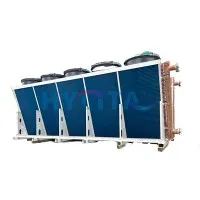
Evaporator coils are crucial components in refrigeration and air - conditioning systems. They play a vital role in the heat - exchange process, where they absorb heat from the surrounding environment, causing the refrigerant inside them to evaporate. As a leading evaporator coil supplier, I have in - depth knowledge of the different types of evaporator coils available in the market. In this blog, I'll introduce you to these various types, their features, and applications.
1. Bare Tube Evaporator Coils
Bare tube evaporator coils are the simplest form of evaporator coils. They consist of a series of straight or bent tubes through which the refrigerant flows. These tubes are usually made of copper or aluminum due to their excellent thermal conductivity.
Advantages
- Simple Design: Their straightforward construction makes them easy to manufacture and install. This simplicity also reduces the cost of production, making them an economical choice for many applications.
- Good Heat Transfer: Copper and aluminum tubes provide efficient heat transfer, allowing the refrigerant to absorb heat effectively from the surrounding air or liquid.
Disadvantages
- Low Surface Area: Compared to other types of evaporator coils, bare tube coils have a relatively low surface area. This limits their heat - transfer capacity, which means they may not be suitable for high - capacity applications.
- Susceptible to Fouling: Since the tubes are exposed, they are more likely to accumulate dirt, dust, and other contaminants over time. This can reduce their efficiency and require more frequent cleaning.
Bare tube evaporator coils are commonly used in small - scale refrigeration systems, such as domestic refrigerators and some small - sized commercial freezers. If you are interested in a cost - effective solution for a low - capacity refrigeration system, Refrigeration Copper Coil might be a good option.
2. Finned Tube Evaporator Coils
Finned tube evaporator coils are an improvement over bare tube coils. They have fins attached to the outside of the tubes, which significantly increase the surface area available for heat transfer.
Types of Fins
- Plate Fins: These are flat, thin sheets of metal (usually aluminum) that are wrapped around the tubes. Plate fins are easy to manufacture and provide a large surface area for heat exchange.
- Spiral Fins: Spiral fins are wound around the tubes in a spiral pattern. They offer better heat - transfer performance than plate fins in some cases, especially when the air flow is parallel to the tube axis.
Advantages


- High Heat - Transfer Efficiency: The increased surface area provided by the fins allows for more efficient heat transfer between the refrigerant and the surrounding medium. This makes finned tube evaporator coils suitable for high - capacity refrigeration and air - conditioning systems.
- Compact Design: Due to their high heat - transfer efficiency, finned tube coils can achieve the same cooling capacity as larger bare tube coils in a more compact space.
Disadvantages
- Higher Cost: The manufacturing process of finned tube coils is more complex than that of bare tube coils, which results in a higher cost.
- Fouling Issues: Although the fins increase the surface area, they can also trap dirt and debris more easily. This requires regular maintenance to ensure optimal performance.
Finned tube evaporator coils are widely used in commercial and industrial air - conditioning systems, large - scale refrigeration plants, and automotive air - conditioning systems. Our Stainless Steel Evap Coil is a high - quality finned tube evaporator coil that offers excellent performance and durability.
3. Microchannel Evaporator Coils
Microchannel evaporator coils are a relatively new type of evaporator coil technology. They consist of small, flat tubes with multiple microchannels inside.
Advantages
- High Heat - Transfer Efficiency: The small size of the microchannels allows for a high surface - area - to - volume ratio, which results in very efficient heat transfer. This makes microchannel evaporator coils highly energy - efficient.
- Lightweight and Compact: Microchannel coils are lighter and more compact than traditional finned tube coils. This makes them ideal for applications where space and weight are critical factors, such as in automotive air - conditioning systems.
- Corrosion Resistance: Microchannel coils are often made of aluminum, which has good corrosion resistance. This extends the lifespan of the coils, especially in harsh environments.
Disadvantages
- High Manufacturing Precision: The production of microchannel evaporator coils requires high - precision manufacturing techniques, which can increase the cost.
- Susceptibility to Clogging: The small size of the microchannels makes them more prone to clogging by debris or contaminants in the refrigerant or air.
Microchannel evaporator coils are increasingly being used in automotive air - conditioning systems, as well as in some high - efficiency residential and commercial air - conditioning units.
4. Shell and Tube Evaporator Coils
Shell and tube evaporator coils are commonly used in large - scale industrial refrigeration and air - conditioning systems. They consist of a shell (a large cylindrical vessel) and a bundle of tubes inside the shell.
Working Principle
The refrigerant flows through the tubes, while the fluid to be cooled (usually water or a brine solution) flows through the shell. Heat is transferred from the fluid in the shell to the refrigerant in the tubes, causing the refrigerant to evaporate.
Advantages
- High Capacity: Shell and tube evaporator coils can handle large volumes of fluid and refrigerant, making them suitable for high - capacity industrial applications.
- Easy Maintenance: The tubes can be easily removed and replaced if they are damaged or need cleaning.
Disadvantages
- Large Size: Shell and tube evaporator coils are relatively large and require a significant amount of space for installation.
- Higher Cost: The manufacturing and installation of shell and tube evaporator coils are more expensive than some other types of coils.
5. Plate Evaporator Coils
Plate evaporator coils are made up of a series of flat plates that are stacked together. The refrigerant and the fluid to be cooled flow through alternate channels between the plates.
Advantages
- High Heat - Transfer Efficiency: The large surface area provided by the plates allows for efficient heat transfer. Plate evaporator coils can achieve a high cooling capacity in a relatively small space.
- Flexible Design: The number of plates can be adjusted according to the required cooling capacity, making plate evaporator coils suitable for a wide range of applications.
Disadvantages
- Sealing Issues: The plates need to be properly sealed to prevent leakage of the refrigerant and the fluid. If the seals fail, it can lead to reduced performance and potential safety hazards.
- Difficult to Clean: Cleaning the interior channels of plate evaporator coils can be challenging, especially if there is a build - up of dirt or scale.
Plate evaporator coils are commonly used in food processing, beverage cooling, and some small - to - medium - sized refrigeration systems.
Evaporator Coil Replacement
Over time, evaporator coils may need to be replaced due to wear and tear, corrosion, or other issues. If you notice a decrease in the cooling performance of your refrigeration or air - conditioning system, it could be a sign that the evaporator coil needs to be replaced. Our Evaporator Coil Replacement service provides high - quality replacement coils and professional installation to ensure that your system operates at its best.
As an evaporator coil supplier, we understand the importance of choosing the right type of evaporator coil for your specific application. Whether you need a small - scale bare tube coil for a domestic refrigerator or a high - capacity shell and tube coil for an industrial refrigeration plant, we have the expertise and products to meet your needs. If you are interested in purchasing evaporator coils or have any questions about our products, please feel free to contact us for a detailed discussion and procurement negotiation.
References
- ASHRAE Handbook - Refrigeration. American Society of Heating, Refrigerating and Air - Conditioning Engineers.
- Incropera, F. P., & DeWitt, D. P. (2002). Fundamentals of Heat and Mass Transfer. John Wiley & Sons.
- Stoecker, W. F., & Jones, J. W. (1982). Refrigeration and Air - Conditioning. McGraw - Hill.