


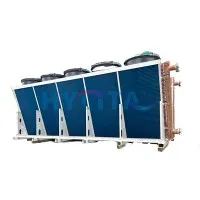
As a seasoned finned tube supplier, I've encountered numerous inquiries about the thermal resistance of finned tubes. In this blog, I'll delve into what thermal resistance is, how it relates to finned tubes, and its significance in various applications.
Understanding Thermal Resistance
Thermal resistance is a fundamental concept in heat transfer, representing the opposition to the flow of heat through a material or a structure. It is analogous to electrical resistance in an electrical circuit, where electrical resistance restricts the flow of electric current. Similarly, thermal resistance restricts the flow of heat.
The unit of thermal resistance is Kelvin per watt (K/W). A higher thermal resistance means that it is more difficult for heat to transfer through the material or structure, while a lower thermal resistance indicates better heat transfer capabilities.
Thermal Resistance in Finned Tubes
Finned tubes are widely used in heat exchangers to enhance heat transfer efficiency. They consist of a base tube with fins attached to its outer surface. The fins increase the surface area available for heat transfer, which in turn improves the overall heat transfer rate.
The thermal resistance of a finned tube can be divided into two main components: the thermal resistance of the base tube and the thermal resistance of the fins.
Thermal Resistance of the Base Tube
The thermal resistance of the base tube is determined by its material properties, thickness, and the temperature difference across it. Materials with high thermal conductivity, such as copper and aluminum, have lower thermal resistance and are therefore better conductors of heat. The thickness of the base tube also affects its thermal resistance; a thicker tube will have a higher thermal resistance than a thinner one.
The thermal resistance of the base tube can be calculated using the following formula:
[R_{tube}=\frac{\ln(\frac{r_{o}}{r_{i}})}{2\pi kL}]
where (R_{tube}) is the thermal resistance of the base tube, (r_{o}) is the outer radius of the base tube, (r_{i}) is the inner radius of the base tube, (k) is the thermal conductivity of the base tube material, and (L) is the length of the base tube.
Thermal Resistance of the Fins
The thermal resistance of the fins is more complex to calculate as it depends on several factors, including the fin geometry, material properties, and the heat transfer coefficient between the fins and the surrounding fluid.
The fins act as extended surfaces that increase the surface area available for heat transfer. However, the heat transfer rate along the fins decreases as the distance from the base tube increases due to the temperature gradient. This phenomenon is known as fin efficiency.
Fin efficiency is defined as the ratio of the actual heat transfer rate from the fin to the maximum possible heat transfer rate if the entire fin were at the base temperature. A higher fin efficiency means that the fins are more effective in transferring heat.
The thermal resistance of the fins can be calculated using the following formula:
[R_{fins}=\frac{1}{hA_{f}\eta_{f}}]
where (R_{fins}) is the thermal resistance of the fins, (h) is the heat transfer coefficient between the fins and the surrounding fluid, (A_{f}) is the total surface area of the fins, and (\eta_{f}) is the fin efficiency.
Factors Affecting the Thermal Resistance of Finned Tubes
Several factors can affect the thermal resistance of finned tubes, including:
Fin Geometry
The geometry of the fins, such as their height, thickness, and spacing, can have a significant impact on the thermal resistance of the finned tube. Taller fins provide a larger surface area for heat transfer, but they also have a lower fin efficiency due to the increased temperature gradient along the fin. Thicker fins have a higher thermal conductivity and can transfer heat more effectively, but they also increase the weight and cost of the finned tube. The spacing between the fins affects the flow of the surrounding fluid and the heat transfer coefficient. A smaller fin spacing can increase the surface area available for heat transfer, but it can also cause flow blockage and reduce the heat transfer coefficient.
Material Properties
The material properties of the base tube and the fins, such as their thermal conductivity, density, and specific heat, can also affect the thermal resistance of the finned tube. Materials with high thermal conductivity, such as copper and aluminum, have lower thermal resistance and are therefore better conductors of heat. The density and specific heat of the material affect its ability to store and transfer heat.
Fluid Properties
The properties of the fluid flowing over the finned tube, such as its thermal conductivity, density, viscosity, and specific heat, can also affect the thermal resistance of the finned tube. Fluids with high thermal conductivity and low viscosity can transfer heat more effectively, resulting in a lower thermal resistance.
Operating Conditions
The operating conditions, such as the temperature difference between the fluid inside the tube and the fluid outside the tube, the flow rate of the fluid, and the pressure, can also affect the thermal resistance of the finned tube. A larger temperature difference can increase the heat transfer rate, but it can also increase the thermal resistance due to the increased temperature gradient. A higher flow rate can increase the heat transfer coefficient, resulting in a lower thermal resistance.
Importance of Thermal Resistance in Finned Tube Applications
The thermal resistance of finned tubes is an important parameter in various applications, including:
Heat Exchangers
Finned tubes are widely used in heat exchangers to transfer heat between two fluids. The thermal resistance of the finned tubes affects the overall heat transfer efficiency of the heat exchanger. A lower thermal resistance means that more heat can be transferred between the two fluids, resulting in a more efficient heat exchanger.
HVAC Systems
Finned tubes are also used in HVAC systems to heat or cool the air. The thermal resistance of the finned tubes affects the performance of the HVAC system. A lower thermal resistance means that the HVAC system can heat or cool the air more effectively, resulting in a more comfortable indoor environment.
Automotive Radiators
Finned tubes are used in automotive radiators to cool the engine coolant. The thermal resistance of the finned tubes affects the cooling efficiency of the radiator. A lower thermal resistance means that the radiator can cool the engine coolant more effectively, resulting in a more reliable engine.
Conclusion
In conclusion, the thermal resistance of a finned tube is a complex parameter that depends on several factors, including the geometry of the fins, the material properties of the base tube and the fins, the fluid properties, and the operating conditions. Understanding the thermal resistance of finned tubes is essential for designing and optimizing heat exchangers, HVAC systems, automotive radiators, and other applications.


As a finned tube supplier, we offer a wide range of finned tubes with different geometries, materials, and specifications to meet the diverse needs of our customers. Our Copper Fin Radiator and Copper Fin Tube Radiators are made of high-quality copper material, which has excellent thermal conductivity and corrosion resistance. Our Aluminum Fin Radiator is made of lightweight aluminum material, which is suitable for applications where weight is a concern.
If you are interested in our finned tubes or have any questions about the thermal resistance of finned tubes, please feel free to contact us. We are always ready to provide you with professional advice and high-quality products.
References
- Incropera, F. P., & DeWitt, D. P. (2002). Fundamentals of Heat and Mass Transfer. John Wiley & Sons.
- Holman, J. P. (2002). Heat Transfer. McGraw-Hill.
- Kakac, S., & Liu, H. (2002). Heat Exchangers: Selection, Rating, and Thermal Design. CRC Press.