


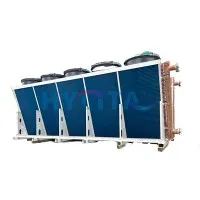
In the supply and custom‑manufacturing of finned‑tube radiators, one of the most frequent questions from customers concerns heat transfer area. It is widely believed that "the taller the fins, the larger the surface area, and the better the heat‑exchange performance". However, with years of industry experience, I have found that fin height is an extremely subtle variable. It not only determines thermal performance but also directly restricts the operating cost and service life of the whole system.
Rather than going over textbook definitions, this article takes an in‑depth look at how fin height affects radiator performance in real‑world engineering selection.
1. Surface Area and Heat‑Transfer Efficiency: Taller Does Not Always Mean Better
Theoretically, taller fins extending from the base tube do create a larger effective contact area with air. For air heaters used in wood drying or food processing, tall fins can deliver a noticeable boost in initial heat‑transfer rate.
Nevertheless, there exists a physical principle of diminishing marginal utility: fin efficiency. Heat takes time to conduct from the tube wall to the fin tip. As fin height increases, the temperature difference between the fin tip and base tube gradually decreases. If fins are made excessively tall, the tip sections receive very little heat and become dead weight instead. Our CFD (Computational Fluid Dynamics) simulations consistently show that blindly increasing fin height wastes raw material while contributing barely anything to total heat exchange capacity.

2. Resistance Is More Than Just Air Resistance
Many engineers overlook pressure drop during the design phase. Taller fins create deeper, more complex airflow passages. Analogous to wind blowing through a narrow alley, overly tall and dense fins cause air to impact the radiator instead of flowing through it. To maintain required air volume, fans with higher power output must be adopted.
Real‑world case: On a previous stainless‑steel radiator project, excessively tall fins raised power consumption of downstream fans by 15%. The long‑term electricity cost far outweighed the minor upfront savings on equipment.
3. Trade‑offs Among Footprint, Weight and Installation
Size is critical for mobile equipment, vehicle‑mounted radiators and aerospace applications. Each additional millimetre in fin height multiplies the overall envelope dimension of the radiator assembly. Furthermore, taller fins consume more metallic material. When copper or stainless steel is specified, radiators gain substantial weight. This raises load requirements for support brackets and creates major difficulties for long‑distance transportation and on‑site hoisting. For compact plate air exchangers, performance balance is generally achieved by optimising fin pitch rather than simply increasing fin height.
4. Manufacturing Challenges Brought by Tall Fins
From the supplier's perspective, greater fin height equals higher processing difficulty.
Bonding strength: For both wrapped fins and sleeved fins, securing sufficient clamping force at fin roots becomes harder as fins grow taller. Loosening under thermal cycling will sharply increase contact thermal resistance.
Yield rate: Tall fins are prone to buckling and wrinkling during production. Apart from poor appearance, deformed fins directly block air channels. For steam exchangers operating under high pressure differential and frequent thermal shock, moderately sized fins tend to offer better mechanical stability and longer service life than extremely tall fins.

Finding the Golden Balance Point
There is no universal formula for determining optimal fin height. Decisions require trade‑offs across the following dimensions:
Fluid medium: Cold water, hot water or high‑temperature steam inside tubes?
Fan characteristics: How much pressure drop can existing fans overcome?
Operating environment: Risk of dust accumulation? (Tall fins are harder to clean.)
Recommendation: Do not sacrifice system pressure performance merely to pursue larger heat‑transfer area. In most industrial scenarios, improving turbulence by optimising FPI (fins per inch) or adopting special fin profiles (slit fins, corrugated fins) delivers better results than simply lengthening fins.
As a professional finned‑tube radiator supplier, we do not only manufacture according to drawings. We also provide parameter optimisation solutions tailored to specific working conditions such as drying, cooling and waste‑heat recovery. If you face challenges in radiator selection or excessive pressure‑drop issues, feel free to reach out. We can work together to figure out the optimal solution based on technical data.