


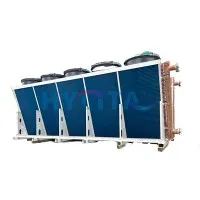
Hey there! As a supplier of heat recovery units, I'm super stoked to dive into how these nifty devices transfer heat. Heat recovery units are like the unsung heroes of the energy - saving world, quietly doing their thing to make our lives more efficient and eco - friendly.
First off, let's understand the basic concept. Heat recovery is all about taking heat that would otherwise go to waste and putting it to good use. It's like recycling, but for heat! In industrial and commercial settings, there's a ton of heat that gets generated during various processes, and a heat recovery unit steps in to capture and transfer this heat.
One of the most common ways a heat recovery unit transfers heat is through a heat exchanger. Think of a heat exchanger as a kind of middleman between two different fluids. You've got a hot fluid on one side and a cold fluid on the other. The heat exchanger allows the heat from the hot fluid to move over to the cold fluid without the two fluids actually mixing. It's like a game of hot potato, but instead of a potato, it's heat being passed around.
There are different types of heat exchangers used in heat recovery units. One popular type is the plate heat exchanger. It consists of a series of thin plates stacked on top of each other. The hot and cold fluids flow through alternate channels between these plates. The large surface area of the plates helps in efficient heat transfer. The heat from the hot fluid seeps through the plates and warms up the cold fluid. Plate heat exchangers are great because they're compact, easy to clean, and have a high heat transfer efficiency.


Another type is the shell and tube heat exchanger. In this one, you've got a large shell that contains a bundle of tubes. The hot fluid flows through the tubes, while the cold fluid flows around the outside of the tubes in the shell. The heat from the hot fluid inside the tubes transfers to the cold fluid in the shell. Shell and tube heat exchangers are often used in large - scale industrial applications because they can handle high pressures and large volumes of fluids.
Now, let's talk about some specific applications of heat recovery units and how heat transfer works in them.
Vapour Economizer in Boiler
A Vapour Economizer in Boiler is an excellent example. In a boiler system, a lot of heat is lost through the flue gases. The vapour economizer steps in to recover some of this wasted heat. The hot flue gases from the boiler pass through the economizer. Inside the economizer, there are tubes filled with water or a working fluid. The heat from the flue gases is transferred to the fluid in the tubes. This pre - heated fluid can then be used in the boiler, reducing the amount of energy needed to heat the water to steam. It's a win - win situation as it saves energy and cuts down on operating costs.
Air Preheater and Economiser
The Air Preheater and Economiser is another important application. In a combustion process, pre - heating the air can significantly improve the efficiency of the system. The hot exhaust gases from the combustion are used to heat up the incoming air. A heat exchanger in the air preheater transfers the heat from the exhaust gases to the fresh air. This pre - heated air is then fed into the combustion chamber. By using the waste heat from the exhaust gases, the fuel required for combustion is reduced, leading to lower emissions and cost savings.
Exhaust Heat Exchanger
An Exhaust Heat Exchanger is commonly used in engines and industrial processes. The hot exhaust gases from an engine or a manufacturing process contain a large amount of heat. The exhaust heat exchanger captures this heat and transfers it to a different fluid, like water or oil. This recovered heat can be used for various purposes, such as heating a building, pre - heating a process fluid, or generating electricity.
But how does the heat actually move from one fluid to another in these heat exchangers? It all comes down to the principles of thermodynamics. Heat naturally flows from a region of higher temperature to a region of lower temperature. In a heat exchanger, the hot fluid has a higher temperature than the cold fluid. The molecules in the hot fluid are moving around more vigorously. When these hot molecules come into contact with the surface of the heat exchanger, they transfer some of their energy to the molecules of the heat exchanger material. These molecules then transfer the energy to the molecules of the cold fluid on the other side.
The rate of heat transfer depends on a few factors. One is the temperature difference between the hot and cold fluids. The bigger the temperature difference, the faster the heat transfer. Another factor is the surface area of the heat exchanger. A larger surface area means more contact between the hot and cold fluids, allowing for more heat to be transferred. The type of material used in the heat exchanger also matters. Materials with high thermal conductivity, like copper and aluminum, are great for heat transfer because they allow heat to pass through them easily.
There are also some additional components in a heat recovery unit that help in the heat transfer process. For example, fans or pumps are used to move the fluids through the heat exchanger. The fans blow the air or the pumps circulate the liquid, ensuring a continuous flow of fluids and a steady heat transfer.
In some advanced heat recovery units, there are also controls and sensors. These sensors monitor the temperature and flow rate of the fluids. The controls can adjust the operation of the unit based on these readings. For instance, if the temperature of the cold fluid is getting too high, the controls can reduce the flow rate of the hot fluid to prevent over - heating.
Heat recovery units are not only beneficial for industrial and commercial applications but also for residential settings. In homes, a heat recovery ventilation system can be installed. It works by exchanging the heat between the stale air being exhausted from the house and the fresh air being brought in. This way, the incoming fresh air is pre - heated, reducing the energy needed to heat the house.
So, as you can see, heat recovery units are pretty amazing. They play a crucial role in conserving energy, reducing costs, and minimizing environmental impact. Whether it's a large - scale industrial plant or a small home, these units can make a big difference.
If you're interested in learning more about our heat recovery units or are thinking about making a purchase, we'd love to have a chat with you. Our team of experts can help you find the right heat recovery solution for your specific needs. Just reach out, and let's start the conversation about how we can make your operations more energy - efficient.
References
- Incropera, F. P., & DeWitt, D. P. (2002). Fundamentals of Heat and Mass Transfer. John Wiley & Sons.
- Cengel, Y. A., & Ghajar, A. J. (2015). Heat and Mass Transfer: Fundamentals and Applications. McGraw - Hill Education.