


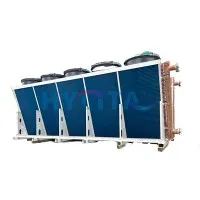
Hey there! As a supplier of finned tube radiators, I've been getting a lot of questions lately about how the air flow rate affects the heat transfer of these radiators. So, I thought I'd take a moment to break it down for you.
First off, let's talk about what a finned tube radiator is. In simple terms, it's a heat exchanger that uses fins to increase the surface area available for heat transfer. This helps to improve the efficiency of the radiator by allowing more heat to be transferred from the hot fluid (usually a liquid) inside the tubes to the surrounding air.
Now, the air flow rate plays a crucial role in this heat transfer process. When air flows over the fins of the radiator, it picks up heat from the fins and carries it away. The faster the air flows, the more heat it can carry away in a given amount of time. This means that increasing the air flow rate can significantly enhance the heat transfer performance of the radiator.
Let's dive a bit deeper into the science behind it. The heat transfer rate in a finned tube radiator can be described by Newton's law of cooling, which states that the rate of heat transfer is proportional to the temperature difference between the hot surface (the fins) and the surrounding air, as well as the heat transfer coefficient. The heat transfer coefficient is affected by several factors, and one of the most important ones is the air flow rate.
When the air flow rate is low, the boundary layer of air near the fins is relatively thick. This boundary layer acts as an insulator, reducing the rate of heat transfer from the fins to the air. As the air flow rate increases, the boundary layer becomes thinner, allowing for more efficient heat transfer. This is because a thinner boundary layer reduces the resistance to heat transfer, enabling heat to move more easily from the fins to the air.
Another aspect to consider is the effect of air flow rate on the distribution of air across the radiator. A uniform air flow distribution is essential for optimal heat transfer. If the air flow is uneven, some parts of the radiator may receive less air, resulting in reduced heat transfer in those areas. By increasing the air flow rate, we can often improve the uniformity of the air distribution, ensuring that all parts of the radiator are effectively cooled.
However, it's not all about increasing the air flow rate indefinitely. There are some limitations and trade - offs. For instance, increasing the air flow rate typically requires more power to drive the fans or blowers that move the air. This means higher energy consumption and potentially higher operating costs. Additionally, at very high air flow rates, there may be an increase in noise levels, which can be a concern in some applications.
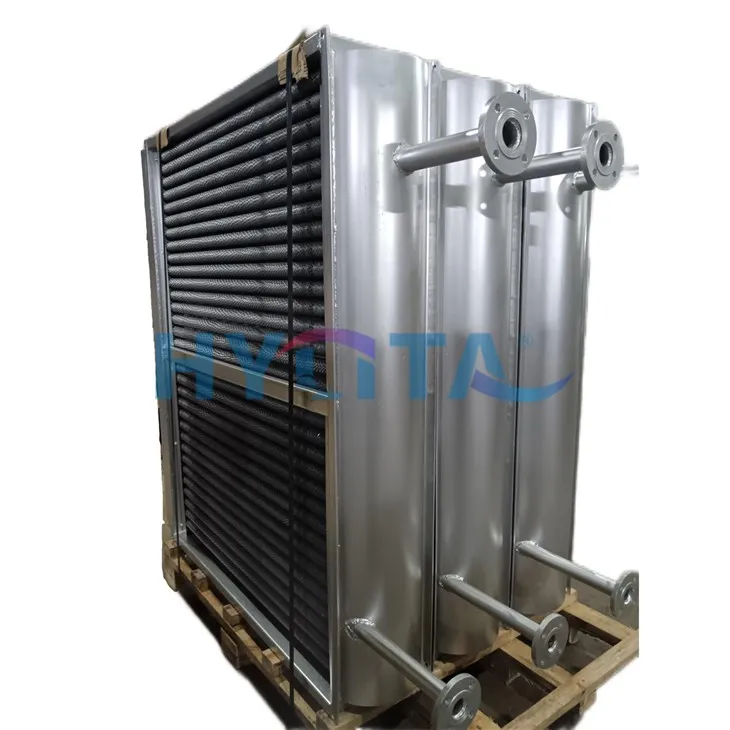

In practical applications, finding the right balance is key. Different types of finned tube radiators have different optimal air flow rates depending on their design, size, and the specific application they are used for. For example, in a Thermal Oil Radiator, the required air flow rate may be different from that of a Copper Finned Tube Vacuum Furnace Heat Exchanger or an SS Radiator.
Let's look at some real - world examples. In industrial settings where large amounts of heat need to be dissipated, such as in power plants or chemical processing facilities, high air flow rates are often used to ensure efficient cooling. These radiators are usually equipped with powerful fans or blowers to achieve the necessary air flow. On the other hand, in smaller applications like automotive radiators or electronic cooling systems, the air flow rate is carefully optimized to balance heat transfer performance with energy consumption and noise levels.
As a supplier, we understand the importance of these factors. We work closely with our customers to determine the most suitable air flow rate for their specific needs. We take into account the type of fluid being cooled, the operating conditions, and the available space and power. By doing so, we can design and supply finned tube radiators that offer the best possible heat transfer performance.
If you're in the market for a finned tube radiator, whether it's a Thermal Oil Radiator, a Copper Finned Tube Vacuum Furnace Heat Exchanger, or an SS Radiator, we're here to help. We have a team of experts who can provide you with detailed technical advice and customized solutions to meet your requirements.
Don't hesitate to reach out to us if you have any questions or if you're interested in discussing a potential purchase. We're always happy to have a chat and see how we can assist you in getting the most efficient and reliable finned tube radiator for your application.
References:
- Incropera, F. P., & DeWitt, D. P. (2002). Fundamentals of Heat and Mass Transfer. Wiley.
- Holman, J. P. (2002). Heat Transfer. McGraw - Hill.