


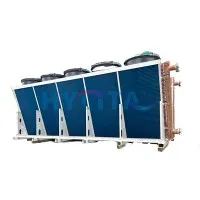
In the efficient operation of fin-and-tube heat exchangers, understanding the factors that affect pressure drop is crucial. One of the most important variables is fin density, which has a profound impact on the performance and efficiency of the heat exchanger. As a quality supplier of fin-and-tube heat exchangers, I have witnessed firsthand how fin density affects the overall pressure drop of the heat exchanger, and I am pleased to share my insights with you.
What is Fin Density?
Fin density refers to the number of fins per unit length on a finned tube, typically measured in fins per inch (FPI) or fins per centimeter (FPC). A higher fin density means more fins are arranged within a given length, thereby increasing the surface area available for heat transfer. However, this also increases the flow resistance as air or fluid passes through the heat exchanger, resulting in a higher pressure drop.
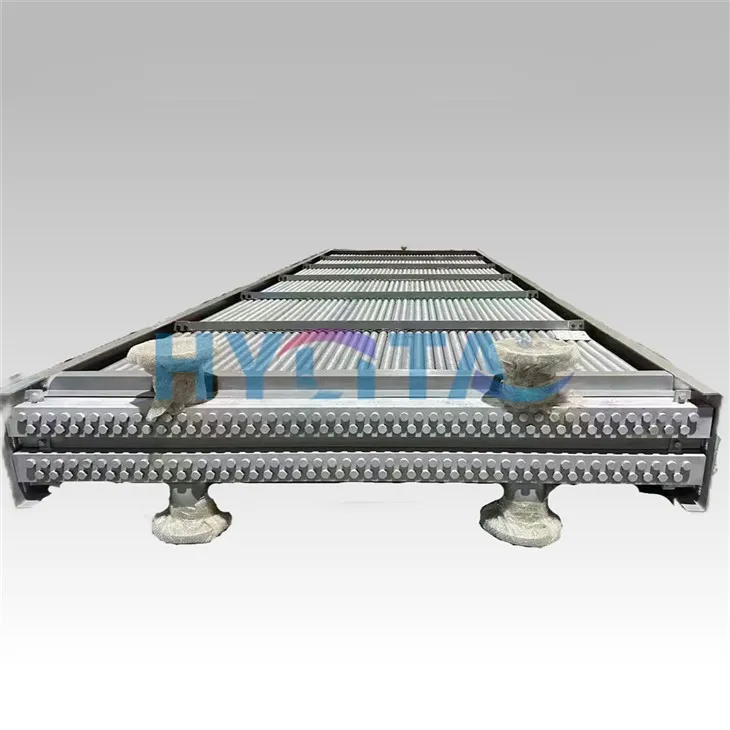
How Does Fin Density Affect Pressure Drop?
The relationship between fin density and pressure drop is complex and depends on multiple factors, including the type of fluid (air or liquid), flow rate, and fin geometry. In general, as fin density increases, the overall pressure drop of the heat exchanger also rises. This is because the additional fins create more friction and turbulence, impeding fluid flow.
This conclusion is supported by classic experimental studies. Turaga (1989) conducted a systematic experimental evaluation of multi-row plate fin-and-tube direct expansion heat exchangers, testing a total of 10 samples with fin densities ranging from 3.1 to 5.5 fins/cm, tube row numbers of 3 to 8, and air-side Reynolds numbers of 300 < Re < 1500, under both dry and wet (dehumidifying) surface conditions. The study found that at a given Reynolds number, both the average air-side heat transfer factor and the pressure drop factor change as fin density increases, confirming that fin density is a key geometric parameter affecting flow resistance.
Let us examine this phenomenon in different scenarios:
Air Flowing Through a Fin-and-Tube Heat Exchanger
In air-cooled heat exchangers, air is forced through the fins by a fan. As air passes over the fins, heat is transferred from the hot fluid inside the tubes to the air. When fin density is low, air can flow through the heat exchanger more freely, resulting in a lower pressure drop. However, because the surface area available for heat transfer is relatively small, heat transfer efficiency may be limited.
On the other hand, high fin density increases the heat transfer surface area, enhancing the heat dissipation capacity of the heat exchanger. But this comes at the cost of increased air resistance. The narrow passages between the fins create a more tortuous path for the air, slowing its velocity and increasing pressure drop. If the pressure drop becomes too great, the fan may be unable to maintain the required airflow, leading to reduced cooling performance.
It is worth noting that the effects of fin density on heat transfer and pressure drop are not always synchronized. Wang et al. (1996) tested 15 plate fin-and-tube heat exchanger samples in an induced flow open wind tunnel, with Reynolds numbers (based on tube collar diameter) ranging from 300 to 7500, and geometric parameters including tube row number, fin spacing, and fin thickness. The study reached an important conclusion: fin spacing does not affect the heat transfer coefficient, the effect of tube row number on the friction factor can also be neglected, and fin thickness likewise does not affect heat transfer or friction characteristics. This means that the idea of simply increasing fin density to improve heat transfer efficiency has its limitations, while pressure drop will genuinely rise with increasing fin density. This finding reminds us that the value of fin density must be carefully weighed in heat exchanger design.
Liquid Flowing Through a Fin-and-Tube Heat Exchanger
For liquid-cooled heat exchangers, the principle is similar but with some differences. The liquid circulating inside the tubes carries heat away from the heat source and releases it to the surrounding environment through the fins. Higher fin density means the liquid has more fins to contact, which can improve heat transfer efficiency. However, this also increases the frictional resistance to liquid flow, causing the overall pressure drop of the heat exchanger to rise.
If the pressure drop is too large, a more powerful pump may be required to maintain the desired flow rate. This not only increases energy consumption but may also cause additional wear on the pump and other system components.

Pressure Drop Deterioration Under Fouling Conditions
In actual operation, fin-and-tube heat exchangers often face fouling issues, and high fin density can significantly amplify the negative impact of fouling on pressure drop. Tang et al. (2017) built a visualized fouling experimental bench for heat exchangers, testing three fin types: plain, wavy, and louvered, with fin spacings ranging from 1.3 to 1.8 mm. Following the GB13270-91 standard, a mixed dust of 72% white clay + 28% carbon black (dust density 2.2 × 10³ kg/m³, median diameter 10 μm) was used. Under conditions of a dust injection concentration of 10.8 g/m³, an air velocity of 1.5 m/s, and a total dust injection duration of 255 min, a differential pressure sensor (OMEGA PX655-01DI) with a range of 0–50 Pa and an accuracy of ±0.3 Pa was used, giving an overall air-side pressure drop error of ±5.0%.
The experiments yielded the following key quantitative data:
| Comparison | Dust Deposition Increase | Pressure Drop Increment Increase After Fouling |
|---|---|---|
| Wavy fins vs. plain fins | +25.6% | +44.4% |
| Louvered fins vs. plain fins | +52.8% | +165.6% |
| Louvered fin spacing 1.5mm vs. 1.8mm | +26.2% | +24.1% |
| Louvered fin spacing 1.3mm vs. 1.8mm | +43.2% | +49.4% |
This dataset clearly reveals a neglected issue: while high fin density may bring heat transfer gains in the initial stage, its pressure drop deterioration after fouling is far greater than that of low fin density solutions. For industrial applications with long-term operation and long maintenance cycles, this factor must be fully considered during selection. In addition, as dust deposition increases, the air-side pressure drop shows a trend of first increasing and then stabilizing.
Applicability Limits of Pressure Drop Correlations
In engineering design, pressure drop correlations are important tools for selection calculations. However, Otović et al. (2018) pointed out that existing correlations in the literature are only applicable within the original authors' own test ranges, and their extrapolation reliability is limited. This study analogized the pressure drop of air through a heat exchanger to that in a porous medium, using the Weisbach (Darcy) friction factor ξ:
Δp_HE = ξ · (L / d_h) · (ρ · w_ε² / 2)
Where the heat exchanger length L = N_l · s_l (number of tube rows × longitudinal tube spacing). Perry and Green (1997) also explicitly pointed out: "Pressure drop is particularly sensitive to geometric parameters, and existing correlations can only be extrapolated to geometries different from the correlation's underlying geometry with extreme caution and conservatism." This means that fin density, as a key geometric parameter, significantly affects the applicability of pressure drop correlations, and engineering selection should give priority to experimental data whose geometric parameters are close to those of the target.
Impact on Heat Exchanger Performance
The overall pressure drop of a heat exchanger is a key parameter that can significantly affect its overall performance. High pressure drop can lead to the following problems:
- Reduced Flow Rate: As mentioned earlier, high pressure drop impedes the passage of air or fluid through the heat exchanger, resulting in reduced flow rate and consequently less heat that can be transferred.
- Increased Energy Consumption: More energy is required to drive the fan or pump to overcome high pressure drop. This increases the operating cost of the heat exchanger and the entire system.
- Noise and Vibration: Excessive pressure drop can cause noise and vibration in the system. This is not only uncomfortable but may also lead to component damage over time.
Finding the Optimal Fin Density
As a fin-and-tube heat exchanger supplier, our goal is to provide heat exchangers that achieve the best balance between heat transfer efficiency and pressure drop. This requires careful consideration of the specific application and operating conditions.
For applications requiring high heat transfer rates where a certain pressure drop can be tolerated, such as industrial cooling systems, higher fin density may be more suitable. However, in applications where energy efficiency and low noise are critical, such as residential or commercial HVAC systems, lower fin density may be more appropriate. At the same time, as shown in the study by Wang et al. (1996), the effect of fin spacing on the heat transfer coefficient may not be significant. Therefore, in certain operating conditions, appropriately reducing fin density in exchange for lower pressure drop and lower fouling sensitivity may be a better engineering choice.
We offer fin-and-tube heat exchangers with a variety of fin densities to meet the diverse needs of our customers. Our hot water heat exchangers are designed for efficient heat transfer in hot water heating systems, while our steam heat exchangers are suitable for applications involving steam or vapor. We also offer steam heat exchangers for efficient heat exchange between steam and other fluids; hot air dryers for drying applications; and thermal oil heat exchangers for thermal oil heating systems.
Conclusion
Understanding the relationship between fin density and pressure drop is essential for selecting the right fin-and-tube heat exchanger for your application. Classic literature shows that increasing fin density does not always lead to a synchronous improvement in the heat transfer coefficient, but the rise in pressure drop is certain, especially under fouling conditions. As a trusted supplier, we have the expertise and extensive experience to help you make informed decisions. Whether you need a heat exchanger for small-scale residential applications or one for large-scale industrial projects, we can provide a solution that meets your specific needs.
If you are interested in learning more about our fin-and-tube heat exchangers, or if you have any questions about fin density and pressure drop, please contact us for a detailed consultation. Our team of experts is ready to assist you in finding the most suitable heat exchanger solution for your needs.
References
Turaga, M. (1989). Experimental Performance Evaluation of Multi-Row, Plate Finned-Tube, Direct Expansion Air Cooling and Dehumidifying Coils. PhD Thesis, Concordia University.
Wang, C. C., Chang, Y. J., Hsieh, Y. C., & Lin, Y. T. (1996). Sensible heat and friction characteristics of plate fin-and-tube heat exchangers having plane fins. International Journal of Refrigeration, 19(4), 223–230.
Otović, M., et al. (2018). Air side pressure drop in plate finned tube heat exchangers. International Journal of Refrigeration.
Tang, J., Zhan, F., Hu, H., Ding, G., & Zhuang, D. (2017). Experimental study on the effect of fin structure on fouling and pressure drop of fin-and-tube heat exchangers. Journal of Refrigeration, 38(1), 1–7. DOI: 10.3969/j.issn.0253-4339.2017.01.001
Qiu, Y. (2019). Analysis of heat transfer performance of louvered fin-and-tube heat exchangers. Refrigeration and Air Conditioning, 19(2), 34–38.