


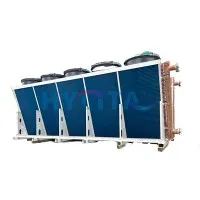
As a supplier of finned tube radiators, I've witnessed firsthand the pivotal role that the number of fins per unit length plays in heat transfer. In this blog post, I'll delve into the science behind this relationship, exploring how it impacts the performance of our radiators and why it matters for your specific applications.
The Basics of Heat Transfer in Finned Tube Radiators
Before we dive into the influence of fin density, let's briefly review the fundamentals of heat transfer in finned tube radiators. These radiators are designed to transfer heat from a hot fluid (such as steam, hot water, or a refrigerant) flowing through the tubes to the surrounding air. The fins, which are attached to the outer surface of the tubes, significantly increase the surface area available for heat transfer, enhancing the radiator's efficiency.
There are three main modes of heat transfer involved in this process: conduction, convection, and radiation. Conduction occurs within the tubes and fins as heat is transferred from the hot fluid to the metal surfaces. Convection takes place when the heated air near the fins rises and is replaced by cooler air, creating a continuous flow of air that carries heat away from the radiator. Radiation, although less significant in most finned tube radiator applications, also contributes to the overall heat transfer by emitting infrared energy from the hot surfaces.
How Fin Density Affects Heat Transfer
The number of fins per unit length, often referred to as fin density, has a profound impact on the heat transfer performance of finned tube radiators. Here's how:
1. Increased Surface Area
One of the primary ways fin density influences heat transfer is by increasing the surface area available for heat exchange. As the number of fins per unit length increases, so does the total surface area of the fins. This larger surface area allows for more contact between the hot metal surfaces and the surrounding air, facilitating greater heat transfer through convection.
For example, consider two finned tube radiators with the same tube diameter and length but different fin densities. The radiator with a higher fin density will have more fins, resulting in a larger total surface area. This increased surface area means that more heat can be transferred from the hot fluid inside the tubes to the air outside, improving the radiator's overall efficiency.
2. Enhanced Convection
In addition to increasing the surface area, a higher fin density can also enhance convection heat transfer. The fins act as extended surfaces that disrupt the boundary layer of air adjacent to the tube surface. This boundary layer is a thin layer of stagnant air that can impede heat transfer. By increasing the fin density, the fins break up the boundary layer, allowing for better mixing of the air and more efficient heat transfer.
Moreover, the increased fin density can create a more turbulent flow of air around the fins. Turbulent flow is characterized by chaotic and irregular motion, which promotes better heat transfer compared to laminar flow. The turbulence helps to carry heat away from the fins more quickly, further improving the radiator's performance.


3. Improved Heat Transfer Coefficient
The heat transfer coefficient is a measure of how effectively heat is transferred between a solid surface and a fluid. A higher heat transfer coefficient indicates better heat transfer performance. Fin density plays a crucial role in determining the heat transfer coefficient of a finned tube radiator.
As the fin density increases, the heat transfer coefficient generally increases as well. This is because the increased surface area and enhanced convection mentioned earlier result in more efficient heat transfer. However, it's important to note that there is a limit to how much the heat transfer coefficient can be improved by increasing fin density. At very high fin densities, the fins may become too closely spaced, causing the air flow to become restricted and reducing the overall heat transfer efficiency.
Finding the Optimal Fin Density
While increasing fin density can improve heat transfer performance, it's not always the case that a higher fin density is better. There are several factors to consider when determining the optimal fin density for a specific application:
1. Airflow
The available airflow around the finned tube radiator is a critical factor in determining the optimal fin density. If the airflow is limited, a very high fin density may cause the air to become restricted, reducing the heat transfer efficiency. In such cases, a lower fin density may be more appropriate to ensure adequate air circulation.
2. Pressure Drop
Increasing the fin density also increases the pressure drop across the radiator. Pressure drop refers to the decrease in pressure that occurs as air flows through the radiator. A higher pressure drop means that more energy is required to move the air through the radiator, which can increase the operating costs. Therefore, it's important to balance the desire for high heat transfer performance with the need to minimize pressure drop.
3. Application Requirements
The specific requirements of the application, such as the temperature difference between the hot fluid and the air, the desired heat transfer rate, and the available space, also play a role in determining the optimal fin density. For example, in applications where space is limited, a higher fin density may be preferred to achieve the required heat transfer performance within a smaller footprint.
Our Finned Tube Radiators and Fin Density
At our company, we understand the importance of fin density in heat transfer and offer a wide range of finned tube radiators with different fin densities to meet the diverse needs of our customers. Our radiators are designed and manufactured using the latest technology and high-quality materials to ensure optimal performance and reliability.
Whether you're looking for a Plate Air Exchanger, an Air To Air Heat Exchanger, or a Hot Water Radiator, we can help you select the right fin density for your application. Our experienced engineers can work with you to understand your specific requirements and recommend the most suitable radiator solution.
Conclusion
In conclusion, the number of fins per unit length has a significant influence on the heat transfer performance of finned tube radiators. By increasing the fin density, we can increase the surface area available for heat exchange, enhance convection heat transfer, and improve the heat transfer coefficient. However, it's important to find the optimal fin density that balances the desire for high heat transfer performance with the need to minimize pressure drop and ensure adequate airflow.
If you're in the market for a finned tube radiator and want to learn more about how fin density can impact your application, we'd love to hear from you. Contact us today to discuss your requirements and explore our range of high-quality finned tube radiators.
References
- Incropera, F. P., & DeWitt, D. P. (2002). Fundamentals of Heat and Mass Transfer. John Wiley & Sons.
- Kays, W. M., & Crawford, M. E. (1993). Convective Heat and Mass Transfer. McGraw-Hill.
- Shah, R. K., & Sekulic, D. P. (2003). Fundamentals of Heat Exchanger Design. John Wiley & Sons.