


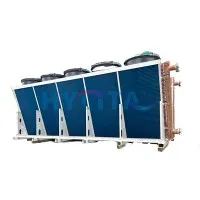
The global heat exchanger industry is undergoing a materials transformation. Copper tubing, long the dominant choice, is facing strong competition from stainless steel. From petrochemical refining to data center cooling, from new energy vehicle thermal management to district heating, stainless steel tubing is becoming the preferred material for a growing number of heat exchange devices, including the heat exchanger coil, thanks to its corrosion resistance, high strength, and cost-effectiveness.
Why Stainless Steel Tubing?
The rise of stainless steel tubing in heat exchangers is driven by a balance of three factors: corrosion resistance, strength, and cost.
Corrosion resistance is the primary consideration. Unlike copper tubing, stainless steel can withstand multiple forms of corrosion. Duplex stainless steels and super austenitic stainless steels combine high strength with good resistance to pitting corrosion and stress corrosion cracking, meeting the demands of high-temperature, high-pressure, and highly corrosive service conditions. Take Alleima (formerly Sandvik) SAF 2707 HD as an example. This high-alloy super duplex stainless steel is designed specifically for highly corrosive conditions: its minimum PRE (pitting resistance equivalent) value is 48, its corrosion resistance in sulfuric acid concentrations up to 50% exceeds that of SAF 2507 and 316L, and after a six-month full-scale heat exchanger test in chlorinated natural seawater at a tube wall temperature of 70°C, no pitting occurred. The material has been deployed in shell and tube heat exchangers in refining, petrochemical, and chemical plants.

Mechanical strength provides a design advantage. Under the condition of 20°C solution-annealed seamless tube (wall thickness ≤4 mm), SAF 2707 HD has a yield strength Rp0.2 of no less than 700 MPa, a tensile strength of 920–1100 MPa, and an elongation of no less than 25%. This means that under the same pressure-bearing requirements, stainless steel tubing can use thinner walls, yielding advantages in weight and material consumption-an important factor in compact coil design and high strength-to-weight ratio applications.
Cost-effectiveness cannot be overlooked. As raw material prices for copper and titanium rise, the cost-performance advantage of stainless steel becomes more pronounced. In power plant condensers, for example, a performance analysis of S44660 super ferritic stainless steel against titanium, brass, and cupronickel shows that this material combines good corrosion resistance, high strength, strong ductility, and low price. It offers excellent techno-economic value in retubing older units and can replace titanium and copper tubes in condensers (the related techno-economic analysis is available on the engineering journal platform of the Chinese Society for Electrical Engineering). In an actual project, two 500 MW sister units in the U.S. Midwest were retubed over five years with SEA-CURE® S44660, replacing the original Admiralty and copper-nickel condenser tubes. The decision was driven by stricter copper discharge limits (NPDES) that copper tubing could not meet (the case was presented at the ASME 2012 Power Conference)
Material Selection: Different Solutions for Different Applications
Stainless steel is not a single material but a family covering many grades. Different service conditions require different types of stainless steel.
Austenitic stainless steels (such as 304, 316, and 316L) are the most commonly used type. They offer good toughness and formability and are the preferred high-PRE corrosion-resistant material in the plate heat exchanger sector. However, 316L stainless steel can no longer meet long-term stable operation requirements in complex corrosive environments such as refinery overhead air coolers, necessitating an upgrade to higher-grade materials.
Duplex stainless steels (such as 2205 and 2507) combine the advantages of austenite and ferrite, with strength and chloride stress corrosion resistance significantly superior to conventional austenitic stainless steels. GB/T 21833.1-2020 specifies the technical requirements for seamless austenitic-ferritic duplex stainless steel tubes for heat exchangers. Comparative corrosion studies of nuclear power plant heat exchangers further confirm this advantage: a comparison of austenitic Cr-Ni and Cr-Ni-Mo steels with 02Cr22Ni5NMo3 (UNS S31803) duplex steel tubes showed that the latter offers significantly improved resistance to intergranular corrosion, pitting, crevice corrosion, corrosion cracking, and erosion. The study also identified, for the first time in a ferritic-austenitic steel structure, special low-energy γ-γ, α-α grain boundaries and α-γ phase boundaries with enhanced corrosion resistance (IAEA INIS database).
Super ferritic stainless steels (such as 444 and 44660) significantly reduce material costs while improving heat transfer efficiency. Industry-chain developments confirm this trend: Tianjin Jinbin Petrochemical has applied 444 super ferritic stainless steel to petrochemical water-cooled tube bundles; Guangdong Xinhui Power Station has batch-used 44660 super ferritic stainless steel for condenser tubes, marking the domestic substitution of this product category in the thermal power heat exchange sector; and Taiyuan Iron & Steel (TISCO), together with CITIC Metal, won a first prize in metallurgical science and technology for its high-performance super ferritic stainless steel project for heat exchangers in special fields (China Iron and Steel Association Stainless Steel Branch).
Varying material by pass is a more refined approach. A patented technology proposes using highly corrosion-resistant 316/316L stainless steel in the first few passes of a multi-pass tube bundle (where the superheated refrigerant gas is contacted), and lower-cost 304/304L stainless steel in the remaining passes, thereby optimizing cost while ensuring performance.
Challenges
Stainless steel tubing is not without its shortcomings. In engineering practice, several issues require close attention.
Fouling is more pronounced. Under mediocre water quality conditions, stainless steel fouls faster than copper, and heat transfer capacity declines noticeably in the later stages of operation. A 2026 study published on ScienceDirect provides specific data: uncoated stainless steel tubes began showing visible calcium sulfate fouling after approximately 400 minutes, while TiOₓ-coated stainless steel tubes only showed visible fouling after approximately 1,100 minutes, extending the induction time by a factor of 2.75; the final fouling thermal resistance of the coated samples was nearly 44% lower than that of the uncoated samples.An earlier comparative study (2010, ScienceDirect) showed that among calcium sulfate deposits on four metal surfaces-copper, aluminum, brass, and stainless steel SS316-the deposition rate order was copper > brass > stainless steel, with higher metal surface thermal conductivity leading to higher initial steady-state temperature and more severe deposition.This means stainless steel heat exchangers require stricter maintenance schedules and more frequent cleaning.
Forming and fabrication are more difficult. Stainless steel is harder and less ductile than copper or aluminum. Thin-walled tubes are prone to cracking and springback, welding requirements are high, intergranular corrosion and post-weld deformation can occur, and the inner wall surface is rough and difficult to finish. These factors place higher demands on manufacturing processes.
Chloride corrosion remains a risk. 304 stainless steel heat exchangers have experienced severe pitting and crack initiation in actual service. High-chloride conditions such as seawater necessitate 316L or higher-grade materials, and the weld heat-affected zone is also prone to sensitization.
Standards and Specifications
The production and use of stainless steel heat exchanger tubes are supported by a well-established standards system.
ASTM A1098/A1098M-18(2022) covers welded austenitic, ferritic, martensitic, and duplex stainless steel tubes for boilers, superheaters, condensers, and heat exchangers. These tubes may have textured configurations on the inner and outer surfaces to improve heat transfer or fluid flow. The standard specifies tube diameters up to 1.5 inches (38 mm) and wall thicknesses up to 2 mm, with textured surfaces produced by cold-forming the substrate surface prior to welding (ASTM official: https://store.astm.org/a1098_a1098m-18r22.html).
GB/T 21833.1-2020 is the Chinese national standard specifically for seamless austenitic-ferritic duplex stainless steel tubes for heat exchangers. It specifies ordering information, dimensions, shape, weight, technical requirements, test methods, inspection rules, and more.
Industry Chain Collaboration Is Accelerating
In June 2026, the Second Technical Exchange Symposium on High-Performance Stainless Steel for Heat Exchangers was held in Taiyuan. More than 120 experts from companies including Alfa Laval, Shanghai Lanbin, Yantai Henghui, Zhejiang Yinlun, and CATL attended. The conference focused on material innovation, engineering applications, cost reduction and efficiency improvement, and green low-carbon development, promoting the large-scale application of stainless steel across the full spectrum of heat exchanger scenarios (TISCO News).
Attending experts noted that the heat exchanger industry is at a critical stage of rapid development. New energy vehicle thermal management systems require materials that remain stable under extreme conditions; data center cooling systems impose stringent requirements on corrosion resistance and thermal conductivity; and new energy storage and district heating sectors urgently need solutions that balance cost and reliability. These evolving demands are forcing the heat exchanger materials sector to accelerate its transition toward high performance, customization, and green development.
What This Means for Designers
Choosing stainless steel tubing as the primary material for a heat exchanger requires a systematic evaluation of the following factors:
Advantages:
- A broad corrosion resistance spectrum, with suitable grades available from normal water quality to strongly acidic or alkaline conditions
- High strength permits thin-wall designs, reducing weight and material costs
- Long service life; super ferritic stainless steel heat exchangers can operate stably for more than 20 years
- Lower maintenance costs than titanium and nickel-based alloys
-
Supports optimized design and advanced heat transfer technology when combined with simulation tools
Trade-offs to consider:
- Higher fouling tendency than copper, requiring more frequent cleaning and maintenance
- Greater forming and fabrication difficulty, with high welding process requirements
- Material selection must be cautious in chloride environments to avoid pitting and stress corrosion
- Lower thermal conductivity than copper, requiring additional heat transfer area as compensation
Therefore, the successful application of stainless steel tubing in heat exchangers is not simply a matter of replacing copper tubes with stainless steel. It requires redesigning the entire heat exchange system around the material characteristics of stainless steel-including tube diameter, wall thickness, fin configuration, circuit design, and cleaning strategy.
Need a Custom Stainless Steel Heat Exchanger Solution? Contact Us.
If you are evaluating stainless steel tube heat exchanger designs, or need stainless steel cooling coils, stainless steel coil coolers, shell and tube cooling coils, titanium cooling coils, or other product solutions, please contact us. As an experienced cooling coil supplier and cooling coil manufacturer, we provide end-to-end support from material selection and simulation to prototyping, helping you find custom cooling coil solutions that balance corrosion resistance, energy efficiency, and cost.
Contact us for a quote and technical consultation.
References
- Incropera, F. P., & DeWitt, D. P. (2002). Fundamentals of Heat and Mass Transfer. John Wiley & Sons.
- Holman, J. P. (2002). Heat Transfer. McGraw - Hill.