


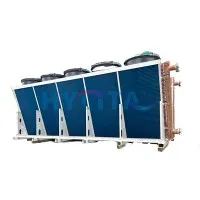
When it comes to industrial cooling solutions, dry coolers play a crucial role in maintaining optimal temperatures for various processes. As a leading dry cooler supplier, we often encounter questions about the differences between single - pass and multi - pass dry coolers. In this blog, we'll delve into the details of these two types of dry coolers, exploring their unique features, advantages, and applications.
Single - Pass Dry Coolers
A single - pass dry cooler is a relatively straightforward cooling system. In a single - pass design, the fluid to be cooled flows through the cooler only once. The coolant enters the cooler at one end and exits at the other after transferring heat to the ambient air.
How it Works
The basic principle of a single - pass dry cooler involves a heat exchanger. The fluid, which could be water, glycol, or other coolants, is pumped through the tubes of the heat exchanger. As ambient air is forced over the tubes by fans, heat is transferred from the fluid inside the tubes to the air. This process cools the fluid, which can then be recirculated back to the system that requires cooling.
Advantages
- Simplicity: Single - pass dry coolers are relatively simple in design and operation. With fewer components and a straightforward flow path, they are easier to install, maintain, and troubleshoot. This simplicity also translates to lower initial costs, making them an attractive option for budget - conscious projects.
- Low Pressure Drop: Since the fluid only passes through the cooler once, there is a relatively low pressure drop across the system. This means that less energy is required to pump the fluid through the cooler, resulting in lower operating costs over the long term.
- Suitability for Low - Load Applications: Single - pass dry coolers are well - suited for applications with relatively low heat loads. For example, in small - scale industrial processes or in cooling systems for residential or light commercial buildings, a single - pass dry cooler can provide efficient cooling without the need for a more complex multi - pass system.
Applications
Single - pass dry coolers are commonly used in applications such as:


- Small - scale industrial processes: In industries where the heat generation is relatively low, such as some food processing plants or small manufacturing facilities, single - pass dry coolers can effectively remove heat from the process fluids.
- HVAC systems for small buildings: For small offices, shops, or residential buildings, single - pass dry coolers can be used as part of the heating, ventilation, and air - conditioning (HVAC) system to cool the refrigerant or other fluids.
Multi - Pass Dry Coolers
In contrast to single - pass dry coolers, multi - pass dry coolers are designed to allow the fluid to pass through the cooler multiple times. This is achieved by dividing the heat exchanger into multiple sections or passes.
How it Works
The fluid enters the multi - pass dry cooler and is directed through a series of passes within the heat exchanger. Each pass allows for additional heat transfer to the ambient air. As the fluid makes multiple passes, it gradually cools down to the desired temperature before exiting the cooler.
Advantages
- Higher Heat Transfer Efficiency: By allowing the fluid to pass through the cooler multiple times, multi - pass dry coolers can achieve a higher degree of heat transfer compared to single - pass coolers. This makes them more suitable for applications with high heat loads, where a greater amount of heat needs to be removed from the fluid.
- Better Temperature Control: Multi - pass dry coolers offer more precise temperature control. The multiple passes allow for a more gradual cooling process, which can result in a more consistent and stable temperature of the cooled fluid. This is particularly important in applications where temperature stability is critical, such as in some high - tech manufacturing processes or in data centers.
- Compact Design: Despite their higher heat transfer efficiency, multi - pass dry coolers can often be designed in a more compact form compared to single - pass coolers with the same cooling capacity. This can be an advantage in applications where space is limited.
Applications
Multi - pass dry coolers are commonly used in the following applications:
- Large - scale industrial processes: In industries such as chemical processing, power generation, and heavy manufacturing, where large amounts of heat are generated, multi - pass dry coolers are essential for maintaining the optimal temperature of process fluids.
- Data centers: Data centers generate a significant amount of heat due to the operation of servers and other equipment. Multi - pass dry coolers are used to cool the coolant that circulates through the servers, ensuring their reliable operation. You can learn more about Server Dry Cooler on our website.
- Containerized applications: For containerized systems, such as mobile data centers or modular industrial units, Container Dry Cooler with multi - pass designs are often used to provide efficient cooling in a limited space.
Comparison between Single - Pass and Multi - Pass Dry Coolers
Heat Transfer Capacity
Single - pass dry coolers have a relatively lower heat transfer capacity compared to multi - pass dry coolers. This is because the fluid only passes through the cooler once, limiting the amount of heat that can be transferred to the ambient air. Multi - pass dry coolers, on the other hand, can achieve higher heat transfer rates due to the multiple passes of the fluid through the heat exchanger.
Cost
In terms of initial cost, single - pass dry coolers are generally less expensive than multi - pass dry coolers. The simpler design and fewer components of single - pass coolers contribute to their lower cost. However, when considering the long - term operating costs, the energy savings associated with multi - pass dry coolers' higher efficiency may offset the initial investment.
Space Requirements
Single - pass dry coolers typically require more space for a given cooling capacity compared to multi - pass dry coolers. The need to achieve sufficient heat transfer in a single pass often results in a larger heat exchanger. Multi - pass dry coolers can be designed more compactly, making them a better choice for applications with limited space.
Maintenance
Single - pass dry coolers are easier to maintain due to their simpler design. There are fewer components and a more straightforward flow path, which means that maintenance tasks such as cleaning and inspection are less complex. Multi - pass dry coolers, while more efficient, may require more frequent maintenance to ensure optimal performance, especially in the internal passages of the multi - pass heat exchanger.
Choosing the Right Dry Cooler
When selecting between a single - pass and a multi - pass dry cooler, several factors need to be considered:
- Heat Load: If the heat load is relatively low, a single - pass dry cooler may be sufficient. However, for high - heat - load applications, a multi - pass dry cooler is usually the better choice.
- Space Constraints: If space is limited, a multi - pass dry cooler's compact design may be more suitable. On the other hand, if space is not a concern, a single - pass dry cooler can be a cost - effective option.
- Budget: Initial budget and long - term operating costs should be considered. While single - pass dry coolers have a lower initial cost, multi - pass dry coolers may offer better energy efficiency and lower operating costs over time.
- Temperature Control Requirements: Applications that require precise temperature control, such as some high - tech manufacturing processes or data centers, are better served by multi - pass dry coolers.
As a dry cooler supplier, we understand the importance of choosing the right cooling solution for your specific needs. Whether you are looking for a Horizontal Dry Cooler for a particular application or need advice on the best type of dry cooler for your project, our team of experts is here to help.
If you are interested in learning more about our dry coolers or would like to discuss your cooling requirements, we invite you to contact us for a detailed consultation. Our experienced sales team can provide you with customized solutions and assist you in making an informed decision.
References
- ASHRAE Handbook - HVAC Systems and Equipment. American Society of Heating, Refrigerating and Air - Conditioning Engineers.
- Perry's Chemical Engineers' Handbook. McGraw - Hill.
- Cooling Tower Institute (CTI) Standards. Cooling Tower Institute.