


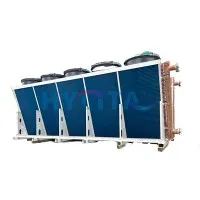
The fin density of a condenser coil is a crucial parameter that significantly impacts the performance and efficiency of a condenser system. As a leading condenser coil supplier, we understand the importance of this factor and its implications for various applications. In this blog post, we will delve into the concept of fin density, its effects on condenser coil performance, and how it relates to different types of condenser units.
Understanding Fin Density
Fin density refers to the number of fins per unit length on a condenser coil. It is typically measured in fins per inch (FPI). The fins on a condenser coil serve to increase the surface area available for heat transfer. By increasing the surface area, more heat can be dissipated from the refrigerant inside the coil to the surrounding air. A higher fin density means more fins are packed into a given length, resulting in a larger surface area for heat exchange.
Importance of Fin Density in Condenser Coil Performance
The fin density of a condenser coil plays a vital role in determining its heat transfer efficiency. A higher fin density generally leads to better heat transfer performance because it provides more surface area for the refrigerant to release heat to the air. This is especially important in applications where high heat transfer rates are required, such as in industrial and data center cooling systems.
However, increasing the fin density also has its drawbacks. As the fin density increases, the air resistance through the coil also increases. This means that more energy is required to force air through the coil, which can lead to higher fan power consumption. Additionally, a higher fin density can make the coil more susceptible to fouling and clogging, as dirt and debris are more likely to accumulate between the closely spaced fins.
Applications and Optimal Fin Density
The optimal fin density for a condenser coil depends on the specific application and operating conditions. Different types of condenser units require different fin densities to achieve the best performance.


Marine Condenser Unit
Marine condenser units are used in ships and other marine vessels to cool the refrigerant in the air conditioning and refrigeration systems. These units are exposed to harsh environmental conditions, including saltwater and high humidity. A Marine Condenser Unit typically requires a lower fin density to prevent fouling and corrosion. A fin density of around 8 - 12 FPI is often recommended for marine applications.
Condenser and Coil for Data Center Cooling
Data centers generate a large amount of heat due to the continuous operation of servers and other electronic equipment. To maintain optimal operating temperatures, data center cooling systems require high heat transfer rates. A Condenser and Coil for Data Center Cooling usually has a higher fin density, typically in the range of 14 - 20 FPI. This allows for efficient heat transfer and helps to keep the data center cool.
Industrial Condenser Unit
Industrial condenser units are used in a wide range of industrial applications, such as chemical processing, food and beverage production, and power generation. These units often need to handle large amounts of heat and may operate in dirty or dusty environments. An Industrial Condenser Unit may require a fin density that balances heat transfer efficiency with resistance to fouling. A fin density of 10 - 16 FPI is commonly used in industrial applications.
Factors Affecting Fin Density Selection
When selecting the fin density for a condenser coil, several factors need to be considered:
Heat Transfer Requirements
The amount of heat that needs to be transferred is a primary factor in determining the fin density. Applications with high heat loads generally require a higher fin density to achieve the necessary heat transfer rates.
Airflow and Fan Power
The available airflow and the power consumption of the fan are also important considerations. A higher fin density increases the air resistance, which requires more fan power to maintain the desired airflow. Therefore, the fin density should be selected to balance heat transfer performance with fan energy consumption.
Environmental Conditions
The environmental conditions in which the condenser unit will operate can also affect the fin density selection. In dirty or dusty environments, a lower fin density may be preferred to reduce the risk of fouling and clogging. In corrosive environments, such as marine applications, a fin material and density that can resist corrosion should be chosen.
Our Expertise as a Condenser Coil Supplier
As a condenser coil supplier, we have extensive experience in designing and manufacturing condenser coils with different fin densities to meet the specific needs of our customers. We use advanced manufacturing techniques and high-quality materials to ensure the performance and reliability of our coils.
Our team of engineers can work closely with you to understand your application requirements and recommend the optimal fin density for your condenser coil. We offer a wide range of condenser coils, including Marine Condenser Unit, Condenser and Coil for Data Center Cooling, and Industrial Condenser Unit, to meet the diverse needs of various industries.
Contact Us for Your Condenser Coil Needs
If you are looking for a reliable condenser coil supplier, we invite you to contact us to discuss your requirements. Our team is ready to provide you with professional advice and high-quality condenser coils that meet your specific needs. Whether you need a custom-designed coil or a standard product, we can offer you the best solutions.
References
- Incropera, F. P., & DeWitt, D. P. (2002). Fundamentals of Heat and Mass Transfer. John Wiley & Sons.
- Kakaç, S., & Pramuanjaroenkij, A. (2005). Heat Exchangers: Selection, Rating, and Thermal Design. CRC Press.
- ASHRAE Handbook - Fundamentals. American Society of Heating, Refrigerating and Air-Conditioning Engineers.