


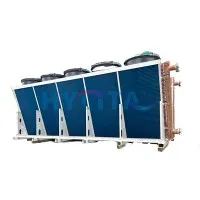
Hey there! As a supplier of dry coolers, I've been getting a lot of questions lately about the function of the coils in a dry cooler. So, I thought I'd take a few minutes to break it down for you and explain why these coils are such a crucial part of the whole system.
First off, let's talk about what a dry cooler actually is. In simple terms, a dry cooler is a heat exchanger that uses ambient air to cool a fluid, usually water or a water-glycol mixture. It's kind of like a big radiator, but instead of using coolant to transfer heat away from an engine, it uses air to cool down the fluid that's flowing through it.
Now, let's get to the coils. The coils in a dry cooler are where the magic happens. They're made up of a series of tubes that are arranged in a specific pattern to maximize the surface area that's exposed to the air. This is important because the more surface area there is, the more heat can be transferred from the fluid inside the tubes to the air outside.
When the fluid enters the dry cooler, it flows through the coils. As it does, the heat from the fluid is transferred to the walls of the tubes. The ambient air is then blown over the coils by fans, which helps to carry the heat away from the tubes and into the atmosphere. This process continues until the fluid has been cooled to the desired temperature.
One of the key functions of the coils is to provide a large surface area for heat transfer. The more surface area there is, the more efficient the heat transfer process will be. This means that the dry cooler can cool the fluid more quickly and with less energy. To achieve this, the coils are often designed with fins that increase the surface area even further. These fins are usually made of aluminum or copper, which are both excellent conductors of heat.
Another important function of the coils is to ensure that the fluid flows evenly through the dry cooler. If the fluid doesn't flow evenly, some parts of the coils may not be getting enough heat transfer, which can lead to hot spots and reduced efficiency. To prevent this, the coils are designed with a specific layout that ensures the fluid is distributed evenly throughout the system.
The material of the coils also plays a crucial role in their function. As mentioned earlier, aluminum and copper are commonly used because of their good heat conductivity. Aluminum is lightweight and corrosion-resistant, which makes it a popular choice for many dry cooler applications. Copper, on the other hand, has even better heat conductivity than aluminum, but it's more expensive. In some cases, a combination of both materials may be used to take advantage of their respective properties.
Now, let's take a look at some of the different types of dry coolers and how the coils function in each one.
Injection Mold Cooling Dry Cooler
Injection mold cooling dry coolers are used to cool the molds in injection molding machines. The coils in these dry coolers are designed to handle the specific cooling requirements of injection molding processes. The high heat generated during the molding process needs to be removed quickly to ensure the quality of the molded products. You can learn more about Injection Mold Cooling Dry Cooler. The coils in these dry coolers are often optimized for high heat transfer rates to keep the mold at the right temperature.
Data Center Dry Cooler
Data centers generate a huge amount of heat from all the servers and equipment. Data center dry coolers are used to remove this heat and keep the environment inside the data center at a stable temperature. The coils in these dry coolers need to be highly efficient to handle the large amount of heat generated. They are often designed with advanced fin designs and materials to maximize heat transfer. Check out Data Center Dry Cooler for more details.
V Dry Cooler
V dry coolers are named for their distinctive V-shaped design. This design allows for a more compact and efficient installation. The coils in V dry coolers are arranged in a V shape to take advantage of this design. The V shape helps to increase the surface area for heat transfer while also reducing the footprint of the dry cooler. You can find more information about V Dry Cooler.
In addition to their primary function of heat transfer, the coils also need to be durable and resistant to corrosion. Since they are constantly exposed to the elements and the fluid flowing through them, they need to be able to withstand the wear and tear over time. This is why proper maintenance of the coils is essential. Regular cleaning and inspection can help to prevent corrosion and ensure that the coils are working at their best.
As a dry cooler supplier, we understand the importance of high-quality coils. That's why we use only the best materials and manufacturing processes to ensure that our dry coolers are as efficient and reliable as possible. Our coils are designed and tested to meet the highest standards of performance and durability.
If you're in the market for a dry cooler, whether it's an Injection Mold Cooling Dry Cooler, a Data Center Dry Cooler, or a V Dry Cooler, we'd love to talk to you. Our team of experts can help you choose the right dry cooler for your specific needs and provide you with all the information you need to make an informed decision.
In conclusion, the coils in a dry cooler are essential for its proper functioning. They provide a large surface area for heat transfer, ensure even fluid flow, and are made of materials that are good conductors of heat. Whether you're cooling injection molds, data centers, or other industrial processes, the coils play a vital role in keeping your systems running smoothly. So, if you have any questions or need a dry cooler for your application, don't hesitate to reach out to us. We're here to help you find the perfect solution.
References:


- Incropera, F. P., & DeWitt, D. P. (2002). Fundamentals of Heat and Mass Transfer. John Wiley & Sons.
- Kreith, F., & Bohn, M. S. (2001). Principles of Heat Transfer. Cengage Learning.