


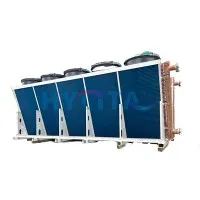
Pressure drop across an oil cooler is a critical parameter that significantly impacts the performance and efficiency of the cooling system. As a leading supplier of oil coolers, we understand the importance of this factor and its implications for various industrial applications. In this blog post, we will delve into the concept of pressure drop, its causes, effects, and how it relates to the operation of our high - quality oil coolers.
Understanding Pressure Drop
Pressure drop, in the context of an oil cooler, refers to the decrease in fluid pressure as the oil flows through the cooler. It is measured as the difference in pressure between the inlet and the outlet of the oil cooler. This phenomenon occurs due to the resistance that the oil encounters while passing through the cooler's internal passages, such as tubes, fins, and flow channels.
The pressure drop can be classified into two main types: major losses and minor losses. Major losses are primarily caused by the friction between the oil and the inner surfaces of the cooler components. This friction is influenced by factors like the length of the flow path, the roughness of the surfaces, and the viscosity of the oil. Minor losses, on the other hand, result from sudden changes in the flow direction or cross - sectional area, such as at bends, valves, and entrances or exits of the cooler.


Causes of Pressure Drop in Oil Coolers
- Geometry of the Cooler Design: The internal design of an oil cooler plays a crucial role in determining the pressure drop. For example, a cooler with a complex network of tubes and fins will have a higher pressure drop compared to a simpler design. Our Air - cooled Industrial Cooler is engineered with an optimized tube and fin arrangement to balance heat transfer efficiency and pressure drop. The carefully designed fin geometry ensures maximum heat dissipation while minimizing the resistance to oil flow.
- Oil Viscosity: Viscosity is a measure of a fluid's resistance to flow. High - viscosity oils, such as those used in heavy - duty industrial applications, tend to experience a higher pressure drop as they flow through the cooler. Temperature also affects oil viscosity; as the oil temperature decreases, its viscosity increases, leading to a greater pressure drop. Our Water - cooled Industrial Cooler is designed to handle a wide range of oil viscosities. The water - cooling mechanism helps maintain the oil at an optimal temperature, reducing the viscosity and thus the pressure drop.
- Flow Rate: The rate at which the oil flows through the cooler is directly proportional to the pressure drop. Higher flow rates result in increased friction and turbulence, leading to a greater pressure drop. However, a higher flow rate is often necessary to achieve the desired heat transfer rate. Our Oil - cooled Industrial Cooler is capable of handling different flow rates while keeping the pressure drop within acceptable limits. By using advanced flow control techniques, we ensure that the cooler can operate efficiently at various flow conditions.
Effects of Pressure Drop
- Pump Performance: A high pressure drop across the oil cooler can put additional strain on the oil pump. The pump needs to work harder to maintain the required flow rate, which can lead to increased energy consumption and premature pump wear. This can result in higher operating costs and more frequent maintenance requirements. Our oil coolers are designed to minimize pressure drop, reducing the load on the pump and extending its service life.
- Heat Transfer Efficiency: While a certain amount of pressure drop is necessary to ensure proper flow distribution and heat transfer within the cooler, an excessive pressure drop can have a negative impact on heat transfer efficiency. It can cause uneven flow patterns, leading to areas of low flow where heat transfer is less effective. By optimizing the pressure drop, our oil coolers ensure uniform flow distribution and maximum heat transfer, resulting in better overall performance.
- System Reliability: High pressure drops can also lead to system instability. Fluctuations in pressure can cause vibrations and noise, which can damage other components in the system. Additionally, if the pressure drop is too high, it may cause the oil flow to stall in some parts of the cooler, leading to overheating and potential damage to the equipment. Our oil coolers are rigorously tested to ensure that they operate within safe pressure drop limits, enhancing the reliability of the entire system.
Measuring and Controlling Pressure Drop
Measuring the pressure drop across an oil cooler is relatively straightforward. Pressure sensors are installed at the inlet and outlet of the cooler, and the difference in pressure readings is recorded. This measurement allows operators to monitor the performance of the cooler and detect any potential issues.
To control the pressure drop, several strategies can be employed. One approach is to select the appropriate oil cooler size and design for the specific application. Our team of experts can help customers choose the right cooler based on factors such as oil flow rate, viscosity, and heat load. Additionally, regular maintenance, such as cleaning the cooler to remove any debris or contaminants, can help reduce the pressure drop.
Our Commitment as an Oil Cooler Supplier
As a leading supplier of oil coolers, we are committed to providing our customers with high - quality products that offer optimal performance and reliability. Our oil coolers are designed using the latest engineering techniques and materials to minimize pressure drop while maximizing heat transfer efficiency. We offer a wide range of Air - cooled Industrial Cooler, Water - cooled Industrial Cooler, and Oil - cooled Industrial Cooler options to meet the diverse needs of our customers.
We also provide comprehensive technical support and after - sales service. Our team of experienced engineers can assist with installation, commissioning, and troubleshooting. We understand that every application is unique, and we work closely with our customers to develop customized solutions that address their specific requirements.
Contact Us for Your Oil Cooler Needs
If you are in the market for a reliable and efficient oil cooler, we invite you to contact us. Our sales team is ready to discuss your application requirements and provide you with a detailed quote. By choosing our oil coolers, you can be confident that you are getting a product that is designed to perform at its best while minimizing pressure drop and ensuring long - term reliability.
References
- Incropera, F. P., & DeWitt, D. P. (2002). Fundamentals of Heat and Mass Transfer. John Wiley & Sons.
- Cengel, Y. A., & Ghajar, A. J. (2015). Heat and Mass Transfer: Fundamentals and Applications. McGraw - Hill Education.
- Idelchik, I. E. (2007). Handbook of Hydraulic Resistance. Begell House Inc.