


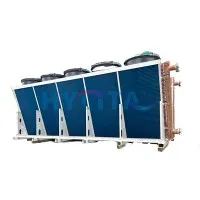
Hey there! As a supplier of dry coolers, I often get asked if dry coolers can be used in food processing plants. Well, let's dive right into it and find out.
First off, what exactly is a dry cooler? A dry cooler is a heat exchanger that uses air to cool a fluid, typically water or a water-glycol mixture. It works by passing the hot fluid through a series of tubes, and then blowing air over the tubes to remove the heat. Unlike traditional cooling towers, dry coolers don't use water evaporation to cool the fluid, which means they don't have the same water consumption and maintenance issues.
Now, let's talk about why dry coolers could be a great fit for food processing plants. One of the biggest advantages is hygiene. In food processing, maintaining a clean and sanitary environment is crucial. Traditional cooling towers can be a breeding ground for bacteria and other contaminants, especially if they're not properly maintained. Dry coolers, on the other hand, don't have any open water sources, which significantly reduces the risk of microbial growth. This is a huge plus for food processing plants, where any contamination can lead to serious health risks and product recalls.
Another important factor is energy efficiency. Food processing plants often have high energy demands, and cooling systems can account for a significant portion of their energy consumption. Dry coolers are generally more energy-efficient than cooling towers because they don't require the energy-intensive process of water evaporation. They also have a smaller footprint, which means they can be installed in smaller spaces, saving on real estate costs.
Dry coolers are also very flexible in terms of installation. They can be installed indoors or outdoors, depending on the specific needs of the food processing plant. This flexibility allows for better integration into existing facilities and can help optimize the overall layout of the plant.
Let's take a look at some of the specific applications of dry coolers in food processing plants. For example, in dairy processing, dry coolers can be used to cool milk during the pasteurization process. This helps to maintain the quality and safety of the milk by quickly reducing its temperature. In meat processing, dry coolers can be used to cool the brine used in the curing process, ensuring that the meat is properly preserved.
Now, let's talk about some of the different types of dry coolers that we offer. We have the Computing Center Dry Cooler, which is designed for high-performance cooling in data centers and other high-tech applications. This type of dry cooler is very efficient and can handle large amounts of heat. We also have the Liquid Immersion Cooling Dry Cooler, which is specifically designed for liquid immersion cooling systems. This type of dry cooler is very effective at removing heat from electronic components that are submerged in a cooling liquid. And finally, we have the Cooler Radiator Dry Cooler, which is a more traditional type of dry cooler that is commonly used in industrial applications.
Of course, like any technology, dry coolers do have some limitations. One of the main limitations is that they are less effective in high ambient temperatures. When the outside air temperature is very high, the dry cooler may not be able to cool the fluid as effectively. However, this can be mitigated by using additional cooling methods, such as pre-cooling the air or using a hybrid cooling system that combines a dry cooler with a traditional cooling tower.
Another limitation is that dry coolers can be more expensive to purchase and install than traditional cooling towers. However, the long-term savings in energy and maintenance costs can often offset the initial investment.
In conclusion, dry coolers can definitely be used in food processing plants. They offer a number of advantages, including hygiene, energy efficiency, and flexibility. While they do have some limitations, these can be overcome with proper planning and design. If you're a food processing plant looking for a reliable and efficient cooling solution, I encourage you to consider using a dry cooler.
If you're interested in learning more about our dry coolers or would like to discuss your specific cooling needs, please don't hesitate to reach out. We'd be happy to help you find the right solution for your food processing plant.
References:


- ASHRAE Handbook of Refrigeration
- Food Processing Technology: Principles and Practice, by P. Fellows