


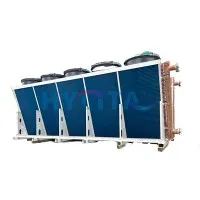
In high - temperature environments, cooling coils play a crucial role in maintaining optimal conditions across various industries. As a cooling coils supplier, I've witnessed firsthand the significance of these components in ensuring the efficient operation of numerous systems. In this blog, I'll delve into how cooling coils work in high - temperature environments, the different types available, and why they are essential.
The Basic Principle of Cooling Coils
Cooling coils operate on the fundamental principle of heat transfer. Heat naturally flows from a region of higher temperature to a region of lower temperature. In a high - temperature environment, the cooling coil serves as a medium through which the excess heat can be removed.
The cooling coil is typically filled with a refrigerant or a coolant. When the hot air from the high - temperature environment comes into contact with the surface of the cooling coil, heat is transferred from the air to the coolant inside the coil. This process cools down the air, and the heated coolant is then pumped away to a heat exchanger or a cooling tower, where the heat is dissipated into the external environment.
The Components Involved
-
The Coil Itself
The coil is usually made of a highly conductive material such as copper or aluminum. These materials have excellent thermal conductivity, which allows for efficient heat transfer from the hot air to the coolant inside the coil. The design of the coil also matters. It is often arranged in a serpentine or spiral pattern to increase the surface area in contact with the hot air, thereby enhancing the heat - transfer efficiency. -
Refrigerant or Coolant
The choice of refrigerant or coolant depends on the specific application and the temperature range. Common refrigerants include R - 134a, R - 410A, etc. These refrigerants have low boiling points, which means they can easily absorb heat and change from a liquid to a vapor state. Once they absorb the heat from the hot air, they are compressed and sent to a condenser, where they release the heat and turn back into a liquid state. -
Fans and Pumps
Fans are used to blow the hot air over the cooling coil, ensuring a continuous flow of air and maximizing the heat - transfer process. Pumps, on the other hand, are responsible for circulating the refrigerant or coolant through the coil and the rest of the cooling system.
Working in High - Temperature Environments
In high - temperature environments, the cooling coils face several challenges. The most obvious one is the large temperature difference between the hot air and the desired cooled temperature. This requires the cooling coils to work more efficiently to remove the excess heat.
-
Higher Heat - Transfer Rates
To achieve higher heat - transfer rates, the cooling coils need to have a larger surface area and a more efficient design. Some advanced cooling coils use micro - channels or fins to increase the surface area even further. These features allow for more contact between the hot air and the coil, facilitating faster heat transfer. -
Robust Construction
High - temperature environments can be harsh on the cooling coils. The materials used in the construction of the coils need to be able to withstand the high temperatures and any corrosive elements present in the environment. For example, in industrial settings where there are chemicals in the air, the coils may need to be made of corrosion - resistant materials such as Titanium Coil. Titanium is known for its excellent corrosion resistance and high strength, making it suitable for use in such challenging conditions. -
Efficient Refrigerant Management
In high - temperature environments, the refrigerant needs to be carefully managed. The compressor may need to work harder to compress the refrigerant, and the condenser may need to dissipate more heat. Some cooling systems use advanced control algorithms to adjust the flow rate and pressure of the refrigerant based on the temperature of the hot air, ensuring optimal performance.
Types of Cooling Coils for High - Temperature Environments
-
Shell and Tube Coil Cooler
The Shell and Tube Coil Cooler is a popular choice for high - temperature applications. It consists of a shell (a large outer container) and a series of tubes inside the shell. The hot fluid (usually air or a gas) flows through the shell, while the coolant flows through the tubes. The large surface area of the tubes allows for efficient heat transfer. This type of cooler is often used in industrial processes where large amounts of heat need to be removed. -
Stainless Steel Coil Cooler
The Stainless Steel Coil Cooler is another option for high - temperature and corrosive environments. Stainless steel is highly resistant to corrosion and can withstand high temperatures. These coolers are commonly used in food processing, chemical, and pharmaceutical industries, where hygiene and durability are of utmost importance.
Benefits of Using Cooling Coils in High - Temperature Environments
-
Equipment Protection
High temperatures can damage sensitive equipment. By using cooling coils to maintain a lower temperature, the lifespan of the equipment can be extended, and the frequency of breakdowns can be reduced. -
Improved Efficiency
In many industrial processes, the efficiency of the process is temperature - dependent. By using cooling coils to control the temperature, the overall efficiency of the process can be improved, leading to cost savings. -
Comfort and Safety
In commercial and residential buildings, cooling coils are used in air - conditioning systems to provide a comfortable and safe environment. In high - temperature environments, such as server rooms or industrial kitchens, cooling coils help prevent overheating and ensure the well - being of the occupants and the proper functioning of the equipment.
Conclusion
Cooling coils are essential components in high - temperature environments. They work by transferring heat from the hot air to a coolant, which is then dissipated into the external environment. Different types of cooling coils, such as shell and tube coil coolers and stainless steel coil coolers, are available to meet the specific needs of various applications. As a cooling coils supplier, I understand the importance of providing high - quality, efficient, and durable cooling solutions.


If you are in need of cooling coils for your high - temperature application, I encourage you to reach out for a detailed discussion. We can work together to find the most suitable cooling coil solution for your specific requirements.
References
- Incropera, F. P., & DeWitt, D. P. (2002). Fundamentals of Heat and Mass Transfer. Wiley.
- ASHRAE Handbook - Fundamentals. American Society of Heating, Refrigerating and Air - Conditioning Engineers.