


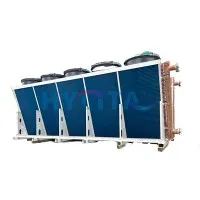
Hey there! As a supplier of cooling coils, I'm super excited to dive into how these nifty devices work in a thermal energy storage system. Let's get started!
What's a Thermal Energy Storage System?
First off, let's quickly chat about thermal energy storage systems. These systems are all about storing thermal energy for later use. They can be used in a bunch of different settings, like industrial plants, commercial buildings, and even some homes. The basic idea is to store energy when it's abundant and cheap, and then use it when it's needed most. This can help save money on energy bills and reduce the strain on the power grid.
The Role of Cooling Coils
Now, let's talk about cooling coils. These are a key component in many thermal energy storage systems. Their main job is to transfer heat from one fluid to another. In a thermal energy storage system, cooling coils are often used to cool a storage medium, like water or a phase-change material.
How Cooling Coils Work
So, how do cooling coils actually work? Well, it all comes down to the basic principles of heat transfer. There are three main ways that heat can be transferred: conduction, convection, and radiation. Cooling coils primarily use conduction and convection to transfer heat.
Conduction
Conduction is the transfer of heat through a solid material. In a cooling coil, the refrigerant (the fluid that absorbs heat) flows through a series of tubes. These tubes are typically made of a material that conducts heat well, like copper or aluminum. As the refrigerant flows through the tubes, it absorbs heat from the surrounding fluid (usually water or air) through the walls of the tubes.
Convection
Convection is the transfer of heat through the movement of a fluid. In a cooling coil, the surrounding fluid (water or air) is circulated over the outside of the tubes. As the fluid passes over the tubes, it picks up heat from the refrigerant inside the tubes. This heated fluid is then removed from the cooling coil and replaced with cooler fluid.
The Refrigeration Cycle
The cooling process in a cooling coil is part of a larger refrigeration cycle. The refrigeration cycle consists of four main components: the compressor, the condenser, the expansion valve, and the evaporator (which is the cooling coil in this case).


- Compressor: The compressor is responsible for compressing the refrigerant gas, which increases its temperature and pressure.
- Condenser: The condenser is where the hot, high-pressure refrigerant gas releases heat to the surrounding environment and condenses into a liquid.
- Expansion Valve: The expansion valve reduces the pressure of the liquid refrigerant, causing it to expand and cool down.
- Evaporator (Cooling Coil): The evaporator is where the cold, low-pressure refrigerant absorbs heat from the surrounding fluid (water or air), causing it to evaporate back into a gas.
This cycle repeats continuously, allowing the cooling coil to maintain a constant temperature and cool the storage medium in the thermal energy storage system.
Types of Cooling Coils
There are several different types of cooling coils available, each with its own unique features and benefits. Here are a few common types:
- Titanium Coil: Titanium coils are known for their excellent corrosion resistance and high heat transfer efficiency. They are often used in applications where the cooling medium is corrosive or where high temperatures are involved. Check out our Titanium Coil for more information.
- Shell and Tube Coil Cooler: Shell and tube coil coolers consist of a series of tubes enclosed in a shell. The refrigerant flows through the tubes, while the cooling medium flows around the outside of the tubes. This design allows for a large surface area for heat transfer, making shell and tube coil coolers very efficient. You can learn more about our Shell and Tube Coil Cooler here.
- Stainless Steel Coil Cooler: Stainless steel coil coolers are durable and resistant to corrosion. They are often used in applications where hygiene is important, such as in food and beverage processing. Take a look at our Stainless Steel Coil Cooler for details.
Benefits of Using Cooling Coils in a Thermal Energy Storage System
There are several benefits to using cooling coils in a thermal energy storage system:
- Energy Efficiency: Cooling coils can help improve the energy efficiency of a thermal energy storage system by reducing the amount of energy needed to cool the storage medium.
- Temperature Control: Cooling coils allow for precise temperature control of the storage medium, which is important for maintaining the effectiveness of the thermal energy storage system.
- Cost Savings: By using a thermal energy storage system with cooling coils, you can save money on energy bills by storing energy during off-peak hours and using it during peak hours.
- Environmental Friendliness: Cooling coils can help reduce the environmental impact of a thermal energy storage system by using less energy and reducing greenhouse gas emissions.
Contact Us for Your Cooling Coil Needs
If you're interested in learning more about our cooling coils or how they can be used in your thermal energy storage system, we'd love to hear from you. Whether you're a large industrial plant or a small business, we have the expertise and products to meet your needs. Just reach out to us and let's start a conversation about how we can help you optimize your thermal energy storage system with our top-quality cooling coils.
References
- Incropera, F. P., & DeWitt, D. P. (2002). Fundamentals of Heat and Mass Transfer. John Wiley & Sons.
- Cengel, Y. A., & Boles, M. A. (2015). Thermodynamics: An Engineering Approach. McGraw-Hill Education.