


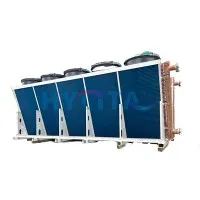
Hey there! As a supplier of cooling coils, I've seen firsthand how these nifty devices play a crucial role in industrial settings. So, let's dive into how cooling coils work in the industrial world.
The Basics of Cooling Coils
First off, what exactly are cooling coils? Well, they're basically heat exchangers. In simple terms, they transfer heat from one medium to another. In an industrial setting, the main goal is usually to cool down a process fluid or gas.
Imagine you've got a manufacturing plant where a certain chemical process generates a ton of heat. If that heat isn't removed, it can cause all sorts of problems, like equipment damage or reduced product quality. That's where cooling coils come in.


The Working Principle
The fundamental principle behind cooling coils is the transfer of heat through a temperature difference. There are two main types of fluids involved: the process fluid (the one that needs to be cooled) and the cooling fluid (usually water or a refrigerant).
Let's say we've got a process fluid flowing through a pipe. The cooling coil is wrapped around or placed in close proximity to this pipe. The cooling fluid circulates inside the coil. As the hot process fluid passes by, heat is transferred from the process fluid to the cooling fluid inside the coil.
This heat transfer happens because of a simple law of nature: heat always moves from a warmer object to a cooler one. So, the hot process fluid loses heat, and the cooling fluid gains it. The cooled process fluid can then continue on its way in the industrial process, while the heated cooling fluid is usually sent to a cooling tower or other heat rejection system to get rid of the excess heat.
Types of Cooling Coils
There are several types of cooling coils available, each with its own advantages and applications.
Titanium Coil
One popular type is the Titanium Coil. Titanium is an excellent material for cooling coils because it's highly corrosion-resistant. In industrial settings where the process fluid might be corrosive, like in some chemical plants or marine applications, titanium coils are a great choice. They can withstand harsh environments and last a long time, reducing the need for frequent replacements.
Shell and Tube Coil Cooler
Another common type is the Shell and Tube Coil Cooler. This design consists of a shell (a large outer container) and a bundle of tubes inside. The process fluid flows through the tubes, while the cooling fluid flows around the tubes in the shell. This type of cooler offers a large surface area for heat transfer, making it very efficient. It's often used in large-scale industrial processes where high heat transfer rates are required.
Stainless Steel Coil Cooler
The Stainless Steel Coil Cooler is also widely used. Stainless steel is strong, durable, and relatively inexpensive compared to some other materials. It's suitable for a wide range of industrial applications, especially those where the process fluid isn't extremely corrosive. Stainless steel coils can handle moderate temperatures and pressures, making them a versatile choice.
Factors Affecting Cooling Coil Performance
Several factors can affect how well a cooling coil works in an industrial setting.
Flow Rate
The flow rate of both the process fluid and the cooling fluid is crucial. If the flow rate of the process fluid is too high, there might not be enough time for proper heat transfer to occur. On the other hand, if the flow rate of the cooling fluid is too low, it won't be able to carry away the heat effectively. Finding the right balance is key to optimizing the performance of the cooling coil.
Temperature Difference
As mentioned earlier, heat transfer depends on the temperature difference between the process fluid and the cooling fluid. A larger temperature difference generally means faster heat transfer. However, there are practical limits to how much of a temperature difference can be achieved, depending on the available cooling fluid and the design of the cooling system.
Surface Area
The surface area of the cooling coil also plays a big role. A larger surface area allows for more contact between the process fluid and the cooling fluid, which in turn increases the rate of heat transfer. That's why some cooling coils are designed with fins or other features to increase their surface area.
Maintenance of Cooling Coils
Proper maintenance is essential to keep cooling coils working efficiently in industrial settings.
Cleaning
Over time, dirt, debris, and scale can build up on the surface of the cooling coil. This can act as an insulator and reduce the rate of heat transfer. Regular cleaning is necessary to remove these deposits. Depending on the type of coil and the environment, cleaning methods can range from simple brushing to chemical cleaning.
Inspection
Regular inspections are also important to check for any signs of damage or wear. Leaks in the coil can lead to loss of cooling fluid and reduced performance. Cracks or corrosion can also compromise the integrity of the coil. By catching these issues early, you can avoid costly breakdowns and repairs.
Why Choose Our Cooling Coils
As a supplier of cooling coils, we've got a lot to offer. Our coils are made from high-quality materials, ensuring durability and long service life. We offer a wide range of types and sizes to meet the specific needs of different industrial applications.
Our team of experts can help you choose the right cooling coil for your process. We understand the unique challenges of industrial settings and can provide customized solutions. Whether you need a corrosion-resistant titanium coil for a chemical plant or a high-capacity shell and tube cooler for a large manufacturing facility, we've got you covered.
Contact Us for Procurement
If you're in the market for cooling coils for your industrial setting, don't hesitate to get in touch. We're here to answer any questions you might have and discuss your procurement needs. Whether you're starting a new project or looking to replace an existing cooling coil, we can work with you to find the best solution.
References
- Incropera, F. P., & DeWitt, D. P. (2002). Fundamentals of Heat and Mass Transfer. John Wiley & Sons.
- Hewitt, G. F., Shires, G. L., & Bott, T. R. (1994). Process Heat Transfer. CRC Press.