


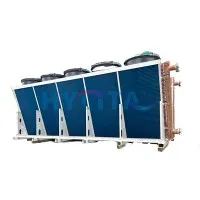
Hey there! As a supplier of condenser coils, I've seen firsthand how these nifty components play a crucial role in cooling systems. In this blog, I'm gonna break down how a condenser coil interacts with other parts in a cooling setup.
Let's start with the basics. A cooling system is like a well - oiled machine, and the condenser coil is one of its key cogs. The main job of a condenser coil is to release heat. It takes the high - pressure, high - temperature refrigerant gas that comes from the compressor and turns it into a high - pressure liquid by removing heat from it.
Interaction with the Compressor
The compressor is like the heart of the cooling system. It sucks in low - pressure refrigerant gas from the evaporator and compresses it, raising its temperature and pressure. Once the compressor has done its job, it sends this super - hot refrigerant gas straight to the condenser coil.
The condenser coil then has to deal with this hot mess. It starts the process of cooling the refrigerant down. The interaction between the compressor and the condenser coil is a continuous cycle. The compressor keeps pumping the hot refrigerant into the coil, and the coil keeps working to cool it. If the condenser coil isn't working properly, it can put a lot of strain on the compressor. For example, if the coil is dirty or blocked, it won't be able to cool the refrigerant efficiently. This means the compressor has to work harder, which can lead to overheating and eventually, compressor failure.


Interaction with the Evaporator
The evaporator is where the cooling actually happens. It absorbs heat from the surrounding air or fluid, which causes the refrigerant inside it to evaporate from a liquid to a gas. The low - pressure refrigerant gas then heads off to the compressor.
The condenser coil and the evaporator are connected in a closed loop. The refrigerant that gets cooled in the condenser coil becomes a high - pressure liquid. This liquid then travels through an expansion valve, which reduces its pressure. Once the pressure is reduced, the refrigerant enters the evaporator. In the evaporator, it absorbs heat and turns back into a gas, and the cycle starts all over again.
This interaction is crucial for maintaining the right temperature in the area being cooled. If the condenser coil can't cool the refrigerant effectively, there won't be enough cold liquid refrigerant reaching the evaporator. As a result, the evaporator won't be able to absorb heat as efficiently, and the cooling system won't work as well.
Interaction with the Fan
Most condenser coils have a fan associated with them. The fan plays a vital role in the heat - transfer process. It blows air over the condenser coil, which helps to remove the heat from the refrigerant inside the coil.
The fan and the condenser coil work hand in hand. The faster the fan blows air over the coil, the more heat can be removed. This is because the moving air carries away the heat that the coil is trying to dissipate. If the fan isn't working correctly, say it's running at a slow speed or is completely broken, the heat transfer rate will drop significantly. This can cause the refrigerant to stay hot for longer, and the cooling system's efficiency will take a nosedive.
Interaction with the Expansion Valve
The expansion valve is a small but important component in the cooling system. Its main job is to control the flow of the high - pressure liquid refrigerant from the condenser coil into the evaporator.
When the high - pressure liquid refrigerant leaves the condenser coil, it enters the expansion valve. The valve restricts the flow of the refrigerant, which causes its pressure to drop suddenly. This drop in pressure makes the refrigerant expand and cool down even further. The cooled refrigerant then enters the evaporator.
The interaction between the condenser coil and the expansion valve is all about getting the right amount of refrigerant into the evaporator at the right pressure. If the expansion valve is stuck open or closed, it can mess up the whole system. For example, if it's stuck open, too much refrigerant will enter the evaporator, which can cause it to freeze up. If it's stuck closed, not enough refrigerant will reach the evaporator, and the cooling system won't work properly.
Different Types of Condenser Coils and Their Applications
We offer a variety of condenser coils for different applications. For data centers, we have the Condenser and Coil for Data Center Cooling. Data centers generate a huge amount of heat, and these coils are designed to handle the high - heat loads efficiently. They are built with high - quality materials that can withstand the constant operation and the specific environmental conditions in a data center.
For marine applications, our Marine Condenser Unit is a great choice. Marine environments are tough, with saltwater, high humidity, and constant movement. Our marine condenser units are corrosion - resistant and designed to work reliably in these harsh conditions.
In industrial settings, we have the Industrial Condenser Unit. Industrial cooling systems often have to deal with large - scale operations and high - heat loads. Our industrial condenser units are built to be robust and efficient, ensuring that they can keep up with the demands of industrial processes.
Why Choosing the Right Condenser Coil Matters
Choosing the right condenser coil is super important. A well - matched condenser coil can improve the overall efficiency of the cooling system. It can reduce energy consumption, which means lower electricity bills. It also extends the lifespan of other components in the system, like the compressor.
On the other hand, a wrong - sized or low - quality condenser coil can cause all sorts of problems. It can lead to poor cooling performance, increased energy costs, and frequent breakdowns. That's why it's crucial to work with a reliable supplier who can help you select the right condenser coil for your specific needs.
Let's Talk Business
If you're in the market for a condenser coil, whether it's for a data center, a marine vessel, or an industrial facility, I'd love to have a chat with you. We have a wide range of high - quality condenser coils that are designed to work seamlessly with other components in your cooling system. Contact us to start the procurement process and let's find the perfect condenser coil for your needs.
References
- ASHRAE Handbook of Refrigeration
- Cooling System Design and Maintenance Manuals