


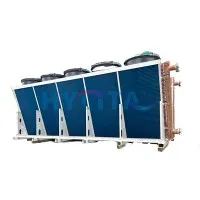
As a supplier of dry coolers, I've witnessed firsthand the transformative impact these systems can have on a building's energy consumption. In this blog, I'll delve into the science behind dry coolers, explore their various types, and illustrate how they contribute to energy efficiency in different building applications.
Understanding Dry Coolers
Dry coolers are heat rejection devices that transfer heat from a fluid (usually water or a water - glycol mixture) to the ambient air without the use of evaporation. They consist of a heat exchanger, a fan, and a frame. The hot fluid flows through the tubes of the heat exchanger, while the fan blows ambient air over the outside of the tubes, causing heat to be transferred from the fluid to the air.
One of the key advantages of dry coolers is their ability to operate in a wide range of environmental conditions. Unlike wet cooling towers, which rely on evaporation to dissipate heat and are therefore sensitive to humidity, dry coolers can function effectively in both high - and low - humidity environments. This makes them a versatile solution for buildings located in various climates.
Types of Dry Coolers
There are several types of dry coolers available in the market, each designed to meet specific requirements.
V Dry Cooler
The V Dry Cooler is a popular choice for many building applications. Its unique V - shaped design allows for a compact footprint while providing a large heat transfer surface area. This design also enhances the airflow through the heat exchanger, improving the overall heat transfer efficiency. The V - shaped configuration enables the dry cooler to be installed in areas with limited space, making it ideal for urban buildings where space is at a premium.
Server Dry Cooler
In the era of digitalization, data centers are becoming increasingly important. The Server Dry Cooler is specifically designed to meet the cooling needs of servers. Servers generate a significant amount of heat, and efficient cooling is crucial to ensure their proper operation and longevity. Server dry coolers are engineered to provide precise temperature control, ensuring that the servers operate within their optimal temperature range. They are also designed to be energy - efficient, helping data centers reduce their energy consumption and operating costs.


Liquid Immersion Cooling Dry Cooler
The Liquid Immersion Cooling Dry Cooler is a cutting - edge technology that is gaining popularity in high - performance computing and data center applications. In liquid immersion cooling, servers are submerged in a dielectric fluid, which absorbs the heat generated by the servers. The liquid immersion cooling dry cooler then removes the heat from the fluid and transfers it to the ambient air. This technology offers several advantages, including higher cooling efficiency, reduced energy consumption, and the ability to handle high - density heat loads.
Impact on Building Energy Consumption
Now, let's explore how dry coolers affect a building's energy consumption.
Reduced Energy for Cooling
One of the primary ways dry coolers reduce energy consumption is by providing an efficient alternative to traditional cooling systems. In many buildings, air - conditioning systems are the largest consumers of electricity. By using a dry cooler to pre - cool the water or refrigerant used in the air - conditioning system, the load on the compressor can be reduced. This results in lower energy consumption for the air - conditioning system, as the compressor doesn't have to work as hard to achieve the desired cooling effect.
For example, in a large commercial building, the air - conditioning system may account for up to 40% of the total energy consumption. By installing a dry cooler to pre - cool the chilled water, the energy consumption of the air - conditioning system can be reduced by 15 - 30%. This translates into significant cost savings for the building owner over the long term.
Elimination of Water - Related Energy Losses
Wet cooling towers, which are commonly used in industrial and commercial buildings, require a significant amount of water for evaporation. In addition to the water consumption, the pumps used to circulate the water in the cooling tower also consume energy. Dry coolers, on the other hand, do not use water for evaporation, eliminating the energy losses associated with water circulation and evaporation. This not only reduces the energy consumption but also helps conserve water, making dry coolers a more sustainable cooling solution.
Energy - Efficient Fan Operation
The fans in dry coolers are designed to operate efficiently. Modern dry coolers are equipped with variable - speed fans, which can adjust their speed based on the cooling demand. This means that the fans only consume the amount of energy necessary to achieve the desired heat transfer. For example, during periods of low cooling demand, the fans can operate at a lower speed, reducing the energy consumption. In contrast, traditional fixed - speed fans in some cooling systems operate at full speed regardless of the cooling demand, resulting in unnecessary energy consumption.
Case Studies
To further illustrate the impact of dry coolers on building energy consumption, let's look at a few case studies.
Commercial Office Building
A commercial office building in a temperate climate was experiencing high energy bills due to its aging air - conditioning system. The building management decided to install a V Dry Cooler to pre - cool the chilled water used in the air - conditioning system. After the installation, the energy consumption of the air - conditioning system decreased by 20%. This reduction in energy consumption was mainly due to the reduced load on the compressor, as the dry cooler was able to lower the temperature of the chilled water before it entered the air - handling units.
Data Center
A data center was struggling to keep up with the cooling demands of its servers while maintaining energy efficiency. By installing a Server Dry Cooler, the data center was able to achieve precise temperature control for its servers. The dry cooler's energy - efficient design and variable - speed fans reduced the overall energy consumption of the cooling system by 25%. This not only saved the data center money but also improved the reliability and performance of the servers.
Conclusion
In conclusion, dry coolers have a significant impact on a building's energy consumption. Their ability to provide efficient heat rejection, reduce the load on cooling systems, eliminate water - related energy losses, and operate with energy - efficient fans makes them an ideal choice for buildings looking to reduce their energy costs and environmental footprint.
Whether you're a building owner, a facility manager, or an engineer, considering a dry cooler for your next project can lead to substantial energy savings. If you're interested in learning more about our dry coolers or discussing a potential project, I encourage you to reach out for a procurement discussion. We have a team of experts ready to assist you in finding the right dry cooler solution for your specific needs.
References
- ASHRAE Handbook - HVAC Systems and Equipment. American Society of Heating, Refrigerating and Air - Conditioning Engineers.
- "Energy - Efficient Cooling Technologies for Buildings." International Energy Agency.
- "Cooling Data Centers with Dry Coolers: A Technical and Economic Analysis." Journal of Sustainable Energy and Buildings.