


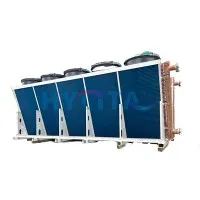
As a provider of economisers for boilers, I am often asked about how these crucial components work in tandem with a blowdown system. In this blog, I'll delve into the intricate details of this relationship, shedding light on the mechanisms, benefits, and practical aspects of integrating an economiser with a blowdown system in a boiler setup.
Understanding the Boiler Economiser
Before we explore the interaction with the blowdown system, let's first understand what a boiler economiser is and what it does. A boiler economiser is a heat exchanger device installed in the boiler system. Its primary function is to recover heat from the flue gases leaving the boiler and transfer this heat to the feedwater entering the boiler. This pre - heating of the feedwater reduces the amount of energy required to heat the water to steam, thereby improving the overall efficiency of the boiler.
There are different types of economisers available, such as the Carbon Steel Economiser. Carbon steel economisers are popular due to their durability and cost - effectiveness. They can withstand high temperatures and pressures while providing efficient heat transfer.
The process of heat transfer in an economiser is based on the principle of thermodynamics. The hot flue gases, which would otherwise be wasted, come into contact with the tubes of the economiser. Inside these tubes, the relatively cold feedwater flows. Through conduction and convection, heat is transferred from the flue gases to the feedwater, raising its temperature. This pre - heated feedwater then enters the boiler, where less fuel is needed to convert it into steam.
The Role of the Blowdown System
A blowdown system is an essential part of a boiler operation. Its main purpose is to remove impurities and dissolved solids from the boiler water. Over time, as water is evaporated in the boiler to produce steam, the concentration of dissolved solids in the remaining water increases. If these solids are not removed, they can lead to scale formation on the boiler tubes, which reduces heat transfer efficiency, increases energy consumption, and can even cause tube failures.
There are two main types of blowdown: continuous blowdown and intermittent blowdown. Continuous blowdown is a constant process where a small amount of water is continuously removed from the boiler to maintain a relatively low concentration of dissolved solids. Intermittent blowdown, on the other hand, is a periodic process where a larger volume of water is removed at set intervals.
How the Economiser Works with the Blowdown System
The relationship between the economiser and the blowdown system is multi - faceted. Firstly, the blowdown water, which is still relatively hot, can be used as a source of heat recovery. When the blowdown water is discharged from the boiler, it contains a significant amount of heat energy. This heat can be recovered using an economiser - like heat exchanger.


The blowdown water passes through a heat exchanger, which can be considered a part of the overall economiser system. In this heat exchanger, the hot blowdown water transfers its heat to the incoming feedwater. This is similar to the heat transfer process that occurs between the flue gases and the feedwater in a traditional economiser. By recovering the heat from the blowdown water, we can further improve the energy efficiency of the boiler system.
Secondly, the operation of the blowdown system can affect the performance of the economiser. If the blowdown is not properly managed, and the concentration of dissolved solids in the boiler water becomes too high, scale can form not only in the boiler but also in the economiser tubes. This scale acts as an insulator, reducing the heat transfer efficiency between the flue gases and the feedwater in the economiser. Therefore, a well - functioning blowdown system is crucial for maintaining the optimal performance of the economiser.
Benefits of Integrating an Economiser with a Blowdown System
Energy Savings
One of the most significant benefits of integrating an economiser with a blowdown system is energy savings. By recovering heat from both the flue gases and the blowdown water, the overall energy consumption of the boiler is reduced. This means less fuel is needed to produce the same amount of steam, resulting in cost savings for the boiler operator.
Extended Equipment Lifespan
A properly functioning blowdown system helps to prevent scale formation in the economiser and the boiler. Scale can cause corrosion and mechanical stress on the tubes, leading to premature failure. By keeping the tubes clean and free from scale, the lifespan of both the economiser and the boiler is extended, reducing maintenance and replacement costs.
Environmental Benefits
Reduced energy consumption also means a lower carbon footprint. Since less fuel is burned to produce steam, fewer greenhouse gas emissions are released into the atmosphere. This makes the boiler system more environmentally friendly and compliant with environmental regulations.
Practical Considerations for Installation and Operation
When installing an economiser and a blowdown system together, several factors need to be considered. Firstly, the sizing of the equipment is crucial. The economiser should be sized according to the boiler's capacity, the flow rate of the feedwater, and the temperature of the flue gases. Similarly, the blowdown system should be sized based on the boiler's water evaporation rate and the allowable concentration of dissolved solids.
The location of the economiser and the blowdown heat exchanger is also important. They should be installed in a way that allows for easy access for maintenance and inspection. Additionally, proper insulation should be provided to minimize heat loss during the heat transfer process.
In terms of operation, regular monitoring and control are essential. The temperature and pressure of the flue gases, feedwater, and blowdown water should be continuously monitored. The blowdown rate should be adjusted based on the water quality and the operating conditions of the boiler.
Heat Energy and Exhaust Recovery
In addition to the heat recovery from the blowdown water, the economiser also plays a vital role in Heat Energy Recovery from the flue gases. The high - temperature flue gases leaving the boiler carry a large amount of heat energy that would otherwise be wasted. The economiser captures this energy and uses it to pre - heat the feedwater.
Moreover, the concept of Heat Exhaust Recovery is closely related to the overall operation of the economiser and the blowdown system. By recovering heat from both the exhaust flue gases and the blowdown water, we can maximize the energy efficiency of the boiler system.
Conclusion
In conclusion, the integration of an economiser with a blowdown system is a smart and efficient way to operate a boiler. The economiser recovers heat from the flue gases and the blowdown water, reducing energy consumption and costs. The blowdown system, in turn, helps to maintain the water quality in the boiler and the economiser, ensuring their optimal performance and longevity.
If you are considering upgrading your boiler system or are in the market for a new economiser, I encourage you to reach out for a consultation. We can provide you with detailed information about our products and how they can be integrated with your existing or new blowdown system. Contact us today to start a conversation about improving the efficiency and performance of your boiler system.
References
- Steam Plant Operation, Babcock & Wilcox
- Boiler Operator's Handbook, Nicklaus P. Cheremisinoff