


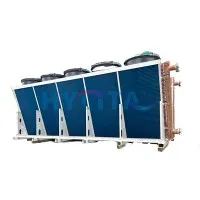
Hey there! As a supplier of condenser coils, I've seen firsthand how crucial the surface area of these coils can be when it comes to performance. So, let's dig into how surface area influences the performance of a condenser coil.
First off, let's talk about what a condenser coil actually does. In simple terms, a condenser coil is a key component in a refrigeration or air - conditioning system. Its main job is to transfer heat from the refrigerant inside the coil to the surrounding environment. When the hot, high - pressure refrigerant flows through the coil, it releases heat and condenses into a liquid state.
Now, let's get into the role of surface area. The surface area of a condenser coil is like the stage where all the heat - transfer action happens. A larger surface area means there's more space for the refrigerant to come into contact with the outside air (or whatever the cooling medium is). This increased contact area allows for more efficient heat transfer.
Think of it like a party. If you have a small room (small surface area), only a limited number of people can interact. But if you have a big hall (large surface area), more people can mingle and exchange ideas. In the case of a condenser coil, more surface area means more opportunities for the heat in the refrigerant to jump over to the cooling medium.
One of the most obvious impacts of a larger surface area is improved heat - transfer rates. When there's more surface available for heat exchange, the refrigerant can release its heat more quickly. This means that the system can cool down faster and maintain a more stable temperature. For example, in an Industrial Condenser Unit, where large amounts of heat need to be dissipated, a condenser coil with a large surface area can significantly enhance the overall efficiency of the unit.
In addition to faster heat transfer, a larger surface area can also reduce the pressure drop across the coil. Pressure drop is basically the loss of pressure as the refrigerant flows through the coil. A high pressure drop can make the system work harder, consuming more energy. With a larger surface area, the refrigerant has more room to flow, which reduces the resistance and thus the pressure drop. This not only saves energy but also extends the lifespan of the compressor and other components in the system.
Another aspect to consider is the effect of surface area on the condensing temperature. The condensing temperature is the temperature at which the refrigerant changes from a gas to a liquid. A larger surface area helps to keep the condensing temperature lower. When the condensing temperature is lower, the compressor doesn't have to work as hard to compress the refrigerant. This results in less energy consumption and lower operating costs.
Let's take a look at some real - world applications. In Condenser and Coil for Data Center Cooling, data centers generate a huge amount of heat. A condenser coil with a large surface area can efficiently remove this heat, ensuring that the servers and other equipment operate at a safe temperature. This is crucial for preventing hardware failures and maintaining the reliability of the data center.
Similarly, in Marine Condenser Unit, where space is often limited and the operating conditions can be harsh, a well - designed condenser coil with an optimized surface area is essential. The coil needs to be able to transfer heat effectively even in a salt - water environment. A larger surface area can compensate for any potential reduction in heat - transfer efficiency due to the corrosive nature of the marine environment.
However, it's not all about just making the surface area as large as possible. There are some trade - offs. A larger surface area usually means a larger and heavier coil. This can increase the installation costs and may require more space. Also, a very large coil can be more difficult to clean and maintain. Dirt, dust, and debris can accumulate on the surface, which can reduce the heat - transfer efficiency over time.
So, as a condenser coil supplier, we need to find the right balance. We use advanced design techniques and materials to maximize the surface area while keeping the size, weight, and maintenance requirements in check. For example, we might use finned tubes. Fins are like little extensions on the surface of the tube that increase the surface area without significantly increasing the size of the coil.
In conclusion, the surface area of a condenser coil plays a vital role in its performance. It affects the heat - transfer rate, pressure drop, condensing temperature, and overall efficiency of the system. Whether it's an industrial application, a data center, or a marine setting, the right surface area can make a big difference.


If you're in the market for a high - performance condenser coil, we'd love to have a chat with you. We can help you find the perfect coil that meets your specific needs and budget. Just reach out to us, and let's start the conversation about how we can improve your cooling system's performance.
References
- Incropera, F. P., DeWitt, D. P., Bergman, T. L., & Lavine, A. S. (2007). Fundamentals of Heat and Mass Transfer. Wiley.
- ASHRAE Handbook - HVAC Systems and Equipment. American Society of Heating, Refrigerating and Air - Conditioning Engineers.