


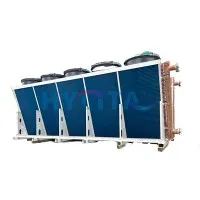
In the realm of heat exchange technology, finned tubes stand as a cornerstone, facilitating efficient thermal transfer across a wide range of applications. As a dedicated finned tube supplier, I've witnessed firsthand the pivotal role that air flow rate plays in determining the performance of these crucial components. In this blog, we'll delve into the intricate relationship between air flow rate and finned tube performance, exploring the underlying principles, practical implications, and the significance of optimizing this parameter for enhanced efficiency.
The Basics of Finned Tubes and Heat Transfer
Before we dive into the impact of air flow rate, let's briefly review the fundamentals of finned tubes and how they function. Finned tubes are essentially heat exchangers that consist of a tube with extended surfaces, or fins, attached to its exterior. These fins serve to increase the surface area available for heat transfer, allowing for more efficient exchange of thermal energy between the fluid inside the tube and the surrounding air.
The process of heat transfer in a finned tube can be broken down into three main mechanisms: conduction, convection, and radiation. Conduction occurs within the tube and fins as heat is transferred from the hot fluid to the cooler surfaces. Convection, on the other hand, involves the transfer of heat between the finned tube surface and the surrounding air through the movement of fluid particles. Radiation plays a relatively minor role in most finned tube applications, but it can still contribute to overall heat transfer, especially at high temperatures.
The Role of Air Flow Rate in Heat Transfer
Now that we have a basic understanding of finned tubes and heat transfer, let's explore how air flow rate affects the performance of these components. The air flow rate, or the volume of air passing over the finned tube per unit of time, has a direct impact on the convective heat transfer coefficient, which is a measure of the rate at which heat is transferred between the finned tube surface and the surrounding air.
As the air flow rate increases, the convective heat transfer coefficient also increases. This is because a higher air flow rate results in more rapid movement of air particles over the finned tube surface, which enhances the mixing of the boundary layer and promotes more efficient heat transfer. In other words, the increased air flow helps to carry away the heat from the finned tube surface more quickly, allowing for a greater temperature difference between the tube and the air and thus increasing the rate of heat transfer.
However, it's important to note that the relationship between air flow rate and heat transfer is not linear. At low air flow rates, increasing the flow rate can lead to a significant increase in the convective heat transfer coefficient. But as the air flow rate continues to increase, the rate of improvement in heat transfer begins to diminish. This is because at high air flow rates, the boundary layer becomes thinner, and the resistance to heat transfer due to the boundary layer decreases. Eventually, the heat transfer rate reaches a point of diminishing returns, where further increases in air flow rate result in only marginal improvements in heat transfer.
Impact on Pressure Drop
In addition to its effect on heat transfer, the air flow rate also has a significant impact on the pressure drop across the finned tube. Pressure drop refers to the decrease in pressure that occurs as air flows through the finned tube bundle. This pressure drop is caused by the resistance to air flow created by the fins and the tube surfaces, as well as the friction between the air and the tube walls.
As the air flow rate increases, the pressure drop across the finned tube also increases. This is because a higher air flow rate requires more energy to overcome the resistance to air flow, resulting in a greater pressure drop. The pressure drop can have several practical implications for finned tube applications. For example, in HVAC systems, a high pressure drop can increase the energy consumption of the fan or blower required to move the air through the system. In industrial applications, a high pressure drop can also limit the flow rate of air through the finned tube bundle, which can reduce the overall heat transfer efficiency.
Optimizing Air Flow Rate for Finned Tube Performance
Given the complex relationship between air flow rate, heat transfer, and pressure drop, optimizing the air flow rate is crucial for achieving the best possible performance from finned tubes. The optimal air flow rate will depend on a variety of factors, including the specific application, the design of the finned tube, and the operating conditions.
In general, the goal is to find a balance between maximizing heat transfer and minimizing pressure drop. This can often be achieved by carefully selecting the finned tube design, including the fin geometry, fin density, and tube arrangement. For example, using fins with a high surface area and a low fin pitch can increase the convective heat transfer coefficient without significantly increasing the pressure drop. Additionally, optimizing the tube arrangement, such as using a staggered tube layout, can also help to improve the heat transfer efficiency and reduce the pressure drop.
Another important consideration when optimizing the air flow rate is the operating conditions of the finned tube. For example, in applications where the air temperature or humidity varies significantly, it may be necessary to adjust the air flow rate to maintain optimal performance. Additionally, in applications where the finned tube is exposed to dirty or corrosive air, regular cleaning and maintenance may be required to prevent fouling and corrosion, which can reduce the heat transfer efficiency and increase the pressure drop.
Practical Applications and Case Studies
To illustrate the importance of air flow rate in finned tube performance, let's consider a few practical applications and case studies.
HVAC Systems
In HVAC systems, finned tubes are commonly used in air handling units, condensers, and evaporators to transfer heat between the air and the refrigerant. The air flow rate in these systems plays a crucial role in determining the efficiency of the heat transfer process. For example, in a commercial building HVAC system, increasing the air flow rate through the finned tube coils can improve the cooling capacity and reduce the energy consumption of the system. However, it's important to ensure that the increased air flow rate does not result in a significant increase in the pressure drop, which could offset the benefits of the improved heat transfer.


Industrial Heat Exchangers
In industrial applications, finned tubes are widely used in heat exchangers for processes such as chemical manufacturing, power generation, and food processing. The air flow rate in these applications can have a significant impact on the overall efficiency and productivity of the process. For example, in a chemical plant, optimizing the air flow rate through the finned tube heat exchangers can improve the heat transfer efficiency and reduce the energy consumption of the plant. Additionally, by carefully controlling the air flow rate, it's possible to prevent overheating or undercooling of the process fluids, which can improve the quality and consistency of the final product.
Conclusion and Call to Action
In conclusion, the air flow rate plays a critical role in determining the performance of finned tubes. By understanding the complex relationship between air flow rate, heat transfer, and pressure drop, and by optimizing these parameters for specific applications, it's possible to achieve significant improvements in the efficiency and effectiveness of finned tube heat exchangers.
As a finned tube supplier, we are committed to providing our customers with high-quality finned tubes that are designed to meet the specific needs of their applications. Whether you're looking for Copper Fin Tube Radiators, Copper Fin Radiator, or Fin Radiator, we have the expertise and experience to help you find the right solution.
If you're interested in learning more about our finned tube products or discussing your specific requirements, please don't hesitate to contact us. Our team of experts is ready to assist you with any questions you may have and to provide you with a customized solution that meets your needs. Let's work together to optimize the performance of your finned tube heat exchangers and achieve greater efficiency and productivity in your operations.
References
- Incropera, F. P., & DeWitt, D. P. (2002). Fundamentals of Heat and Mass Transfer. Wiley.
- Kays, W. M., & London, A. L. (1998). Compact Heat Exchangers. McGraw-Hill.
- Shah, R. K., & Sekulic, D. P. (2003). Fundamentals of Heat Exchanger Design. Wiley.