


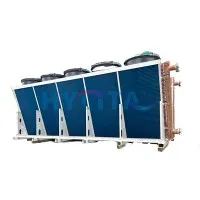
Hey there! As a supplier of economisers in boilers, I often get asked about the function of fins in an economiser. So, I thought I'd take a few minutes to break it down for you.
First off, let's talk about what an economiser is. An economiser is a heat exchanger that recovers heat from the flue gas in a boiler system. It pre - heats the feedwater going into the boiler, which helps to improve the overall efficiency of the boiler. And that's where fins come into play.
The Basics of Fins in an Economiser
Fins are basically extended surfaces that are attached to the tubes of an economiser. You can think of them as little heat - grabbing fingers. Their main job is to increase the surface area available for heat transfer. In a regular tube, the heat transfer occurs only on the outer surface of the tube. But when you add fins, you're multiplying that surface area significantly.
For example, if you have a smooth tube with a certain diameter and length, it has a fixed surface area. But once you attach fins to it, you're adding extra surface area all along the length of the tube. This means that more heat from the flue gas can be transferred to the feedwater inside the tube.
Enhanced Heat Transfer
One of the key functions of fins in an economiser is to enhance heat transfer. The flue gas flowing over the economiser tubes is full of heat energy. Without fins, the heat transfer rate might be limited because the contact area between the gas and the tube is relatively small.
When fins are present, they act as conductors. The flue gas comes into contact with the fins, and the heat is first transferred to the fins. Since the fins are made of a good heat - conducting material (usually metals like steel or aluminum), they quickly transfer this heat to the tube wall. From there, the heat is transferred to the feedwater inside the tube.
This enhanced heat transfer is crucial for the efficiency of the boiler. By recovering more heat from the flue gas, we can reduce the amount of fuel needed to heat the feedwater to the required temperature. And that translates into cost savings for the end - user.
Improved Energy Efficiency
As I mentioned earlier, the more heat we can recover from the flue gas, the better the energy efficiency of the boiler. Fins play a vital role in this. They help in maximizing the heat recovery process.


Let's say you have a boiler system without fins in the economiser. The flue gas might leave the system with a relatively high temperature, taking a lot of valuable heat energy with it. But when you have fins in the economiser, they work hard to extract as much heat as possible from the flue gas. This means that the flue gas leaves the system at a lower temperature, and more of the heat energy has been transferred to the feedwater.
This improved energy efficiency not only saves money on fuel costs but also has environmental benefits. By using less fuel, we're reducing the carbon footprint of the boiler system. It's a win - win situation!
Types of Fins and Their Advantages
There are different types of fins used in economisers, and each has its own advantages. For instance, spiral fins are quite popular. They are wound around the tube in a spiral pattern. This design has a few benefits. Firstly, it provides a continuous and uniform increase in surface area along the length of the tube. Secondly, the spiral shape can create a swirling effect in the flue gas flow, which further enhances heat transfer.
Another type is the straight fin. Straight fins are simple and easy to manufacture. They are attached perpendicular to the tube surface. They are great for applications where a large amount of surface area needs to be added quickly and cost - effectively.
Impact on Economiser Design
Fins also have an impact on the overall design of the economiser. When designing an economiser, engineers need to consider factors like the type of fins, their density, and their height. The density of fins refers to how closely spaced they are on the tube. A higher fin density means more surface area, but it can also increase the pressure drop of the flue gas flow.
The height of the fins also matters. Taller fins can provide more surface area, but they might be more prone to fouling (the build - up of dirt and debris). So, it's all about finding the right balance to optimize the performance of the economiser.
Our Products and Fins
At our company, we understand the importance of fins in an economiser. That's why we offer a range of economisers with different fin configurations. Whether you need a Economiser Heat Exchanger for a small - scale industrial boiler or a large - scale power plant boiler, we've got you covered.
Our Heat Energy Recovery economisers are designed to make the most of the fin technology. We use high - quality materials for the fins to ensure long - lasting performance and efficient heat transfer. And if you're looking for a durable option, our Carbon Steel Economiser with well - designed fins is a great choice.
Why Choose Our Economisers with Fins
When you choose our economisers, you're getting a product that has been carefully engineered to maximize the benefits of fins. We've done extensive research and testing to ensure that our fin designs are optimized for heat transfer and energy efficiency.
Our team of experts is always available to help you select the right economiser for your specific needs. Whether you're looking to upgrade an existing boiler system or install a new one, we can provide you with the best solutions.
Conclusion and Call to Action
In conclusion, fins in an economiser are essential for enhancing heat transfer, improving energy efficiency, and reducing operating costs. They play a crucial role in the overall performance of a boiler system.
If you're in the market for an economiser for your boiler, we'd love to talk to you. We can provide you with detailed information about our products, answer any questions you might have, and help you make an informed decision. Don't hesitate to reach out to us for a consultation and to discuss your procurement needs. Let's work together to make your boiler system more efficient and cost - effective!
References
- "Heat Exchanger Design Handbook", by Rohsenow, Hartnett, and Cho.
- "Boiler Efficiency and Operation", various industry publications.