


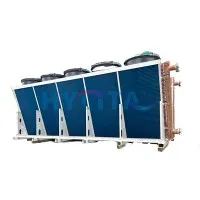
The performance of an evaporator coil is a critical factor in the efficiency and effectiveness of any refrigeration or air - conditioning system. As a leading evaporator coil supplier, I've witnessed firsthand how various factors can impact the performance of these coils, and one of the most significant factors is the airflow rate. In this blog post, I'll delve into how the airflow rate affects the performance of an evaporator coil and why it matters for your business.
Heat Transfer Mechanism in Evaporator Coils
Before we explore the impact of airflow rate, it's essential to understand the basic heat transfer mechanism in an evaporator coil. The primary function of an evaporator coil is to absorb heat from the surrounding air. Refrigerant inside the coil evaporates as it absorbs heat, changing from a liquid to a vapor state. This process cools the air passing over the coil, which is then circulated into the desired space.
The heat transfer rate (Q) in an evaporator coil can be described by the following equation: (Q = U \times A\times\Delta T_{lm}), where (U) is the overall heat transfer coefficient, (A) is the surface area of the coil, and (\Delta T_{lm}) is the log - mean temperature difference between the refrigerant and the air.
Impact of Airflow Rate on Heat Transfer
1. Effect on the Overall Heat Transfer Coefficient ((U))
The overall heat transfer coefficient (U) is a measure of the combined resistance to heat transfer through the coil and the air film. The airflow rate has a significant impact on the convective heat transfer coefficient ((h)) on the air - side of the coil, which is a major component of (U).
When the airflow rate increases, the convective heat transfer coefficient (h) on the air - side also increases. This is because a higher airflow rate results in more turbulent air flow over the coil surface. Turbulence enhances the mixing of air near the coil surface, reducing the thickness of the boundary layer. A thinner boundary layer means less resistance to heat transfer, which in turn increases the convective heat transfer coefficient. As a result, the overall heat transfer coefficient (U) increases, leading to a higher heat transfer rate (Q).


Conversely, when the airflow rate is too low, the air flow over the coil becomes laminar. In laminar flow, the boundary layer is thicker, and there is less mixing of air near the coil surface. This increases the resistance to heat transfer, reducing the convective heat transfer coefficient (h) and the overall heat transfer coefficient (U). Consequently, the heat transfer rate (Q) decreases.
2. Effect on the Log - Mean Temperature Difference ((\Delta T_{lm}))
The log - mean temperature difference (\Delta T_{lm}) is also affected by the airflow rate. When the airflow rate is increased, the temperature of the air leaving the coil is closer to the inlet refrigerant temperature. This is because more heat is transferred from the air to the refrigerant in a shorter time due to the increased heat transfer rate. As a result, the log - mean temperature difference (\Delta T_{lm}) decreases.
However, the increase in the overall heat transfer coefficient (U) due to the higher airflow rate usually compensates for the decrease in (\Delta T_{lm}), resulting in an overall increase in the heat transfer rate (Q).
Impact on Coil Capacity and Efficiency
1. Coil Capacity
The capacity of an evaporator coil is defined as the amount of heat it can remove from the air per unit time. As we've seen, an appropriate increase in the airflow rate can increase the heat transfer rate (Q), which means the coil can remove more heat from the air. Therefore, the capacity of the coil increases with an increase in the airflow rate up to a certain point.
However, if the airflow rate is too high, the refrigerant may not have enough time to fully evaporate. This can lead to liquid refrigerant entering the compressor, which is known as "liquid slugging." Liquid slugging can cause severe damage to the compressor and reduce the overall system performance.
2. Coil Efficiency
The efficiency of an evaporator coil is related to how effectively it can transfer heat from the air to the refrigerant. A higher airflow rate can improve the efficiency of the coil by increasing the heat transfer rate. But it's important to maintain a balance. If the airflow rate is too low, the coil may not be able to transfer enough heat, leading to poor efficiency. On the other hand, if the airflow rate is too high, the increased power consumption of the fan may offset the benefits of increased heat transfer, resulting in a decrease in overall system efficiency.
Impact on Air Quality and Comfort
The airflow rate also has an impact on air quality and comfort. A proper airflow rate ensures that the air is evenly cooled and circulated throughout the space. If the airflow rate is too low, there may be temperature stratification in the space, with warmer air near the ceiling and cooler air near the floor. This can lead to uneven comfort levels for the occupants.
In addition, a sufficient airflow rate helps to remove moisture from the air. As the air passes over the cold evaporator coil, water vapor in the air condenses on the coil surface. The condensed water is then drained away. A low airflow rate may not allow enough moisture to be removed from the air, resulting in a humid environment, which can be uncomfortable and may also promote the growth of mold and bacteria.
Our Evaporator Coil Products
As an evaporator coil supplier, we offer a wide range of high - quality evaporator coils to meet different customer needs. Our Refrigeration Copper Coil is known for its excellent heat transfer performance and corrosion resistance. Copper has high thermal conductivity, which allows for efficient heat transfer. Our Stainless Steel Evap Coil is a great choice for applications where corrosion resistance is a priority, such as in harsh environments.
If you need to replace an existing evaporator coil, our Evaporator Coil Replacement service can provide you with a suitable replacement coil and professional installation.
Conclusion
The airflow rate plays a crucial role in the performance of an evaporator coil. It affects the heat transfer rate, coil capacity, efficiency, air quality, and comfort. As a professional evaporator coil supplier, we understand the importance of proper airflow rate and can provide you with the right evaporator coil solutions for your specific needs.
If you are interested in our evaporator coil products or have any questions about airflow rate and coil performance, please feel free to contact us for procurement and further discussions. We are committed to providing you with the best products and services to ensure the optimal performance of your refrigeration or air - conditioning system.
References
- Incropera, F. P., & DeWitt, D. P. (2002). Fundamentals of Heat and Mass Transfer. Wiley.
- ASHRAE Handbook - Fundamentals. American Society of Heating, Refrigerating and Air - Conditioning Engineers.