


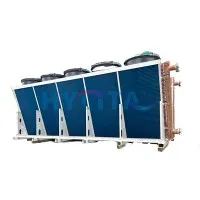
In today's world, where energy efficiency is not just a buzzword but a crucial factor for businesses and households alike, the role of energy - saving devices cannot be overstated. As a supplier of Hot Water Economiser, I am often asked about the potential savings that a hot water economiser can bring to energy costs. In this blog post, I will delve into the science behind hot water economisers and quantify their energy - saving capabilities.
Understanding the Basics of a Hot Water Economiser
A hot water economiser is a heat exchanger device designed to recover waste heat from exhaust gases or other hot fluid streams. It uses this recovered heat to pre - heat the feedwater going into a boiler or other hot water system. By pre - heating the water, the boiler or heating system doesn't have to work as hard to raise the water temperature to the desired level, thus reducing the amount of fuel or energy required.


The principle behind a hot water economiser is based on the laws of thermodynamics. Heat always flows from a hotter object to a cooler one. In industrial processes or even in large - scale domestic heating systems, a significant amount of heat is wasted in the form of hot exhaust gases. A hot water economiser capitalises on this by transferring the heat from these exhaust gases to the incoming cold water.
Factors Affecting Energy Savings
Several factors influence how much a hot water economiser can save on energy costs.
1. Temperature Difference
The greater the temperature difference between the hot exhaust gases and the incoming cold water, the more heat can be transferred. For example, in a high - temperature industrial process where exhaust gases can reach several hundred degrees Celsius, a hot water economiser can recover a substantial amount of heat. If the exhaust gas temperature is around 300°C and the incoming water temperature is 20°C, a well - designed economiser can transfer a large amount of heat, significantly reducing the energy needed to heat the water further.
2. Flow Rates
The flow rates of both the exhaust gases and the incoming water also play a crucial role. If the flow rate of the exhaust gases is too high, the contact time between the gases and the economiser tubes may be insufficient for effective heat transfer. On the other hand, if the water flow rate is too low, the water may overheat in the economiser, leading to inefficiencies. A proper balance of these flow rates is essential for optimal energy savings.
3. System Efficiency
The efficiency of the hot water economiser itself is a key factor. High - quality economisers with advanced heat transfer surfaces, such as finned tubes, can transfer heat more effectively than basic models. Additionally, the overall efficiency of the heating system in which the economiser is installed also matters. A more efficient boiler or heating system will make better use of the pre - heated water, resulting in greater energy savings.
Calculating Energy Savings
To estimate the energy savings provided by a hot water economiser, we can use some basic calculations.
Let's assume we have an industrial boiler system. The boiler consumes natural gas to heat water. The energy content of natural gas is approximately 38 MJ/m³.
First, we need to determine the amount of heat recovered by the economiser. The heat transfer equation is (Q = m\times c\times\Delta T), where (Q) is the heat transferred, (m) is the mass flow rate of the water, (c) is the specific heat capacity of water ((c = 4.18 kJ/kg\cdot K)), and (\Delta T) is the temperature increase of the water.
Suppose the mass flow rate of the incoming water (m = 1000 kg/h), and the economiser increases the water temperature from 20°C to 60°C. Then (\Delta T=60 - 20 = 40K).
The heat transferred (Q=m\times c\times\Delta T=1000 kg/h\times4.18 kJ/kg\cdot K\times40K = 167200 kJ/h)
Converting this to MJ, (Q = 167.2 MJ/h)
If the boiler efficiency is 80%, the amount of natural gas that would have been required to heat the water without the economiser is (Q_{gas}=\frac{Q}{\eta}), where (\eta) is the boiler efficiency. So (Q_{gas}=\frac{167.2 MJ/h}{0.8}=209 MJ/h)
The volume of natural gas saved per hour is (V=\frac{Q_{gas}}{38 MJ/m³}\approx5.5 m³/h)
If natural gas costs $0.5 per cubic meter, the savings per hour would be (5.5 m³/h\times0.5 = $2.75)
Over a year (assuming 8000 operating hours), the savings would amount to (2.75\times8000=$22000)
Real - World Examples
In industrial settings, the savings can be even more significant. For instance, in a large - scale food processing plant, where hot water is used extensively for cleaning, cooking, and sterilization processes. A hot water economiser installed in the exhaust system of the plant's boilers can save a substantial amount of energy.
One such case study involved a food processing plant with a high - temperature exhaust stream. After installing a Hot Water Economiser, they were able to reduce their natural gas consumption by approximately 20%. This translated into annual savings of over $100,000.
In the commercial sector, large hotels or hospitals also benefit from hot water economisers. These facilities have a continuous demand for hot water for various purposes such as showers, laundry, and dishwashing. By installing a hot water economiser, they can reduce their energy bills and also contribute to a more sustainable environment.
Comparison with Other Heat Recovery Systems
It's worth comparing hot water economisers with other heat recovery systems like Exhaust Heat Exchanger and Air Preheater and Economiser.
Exhaust heat exchangers are more general - purpose devices that can be used to recover heat from exhaust gases for various applications, not just for heating water. They can be used to heat air, other fluids, or even to generate steam. While they offer similar energy - saving principles, a hot water economiser is more specifically designed for heating water, which can make it more efficient in that particular application.
Air preheaters and economisers are often used in power plants. They pre - heat the combustion air as well as the feedwater. A hot water economiser, on the other hand, focuses solely on pre - heating the water. In some cases, a combination of these systems may be used to maximise energy savings.
Conclusion and Call to Action
In conclusion, a hot water economiser can lead to significant savings on energy costs, whether in industrial, commercial, or large - scale domestic applications. The actual savings depend on various factors such as temperature difference, flow rates, and system efficiency. However, in most cases, the return on investment for a hot water economiser is relatively short, usually within a few years.
If you are looking to reduce your energy costs and make your heating systems more efficient, a hot water economiser is a viable solution. As a supplier of high - quality hot water economisers, we are committed to providing you with the best products and technical support. Whether you have specific requirements for your industrial process or need a solution for a commercial building, we can help you find the most suitable hot water economiser for your needs. Contact us today to start the procurement process and discuss how we can help you achieve substantial energy savings.
References
- Incropera, F. P., & DeWitt, D. P. (2002). Fundamentals of Heat and Mass Transfer. John Wiley & Sons.
- ASHRAE Handbook (2017). HVAC Systems and Equipment. American Society of Heating, Refrigerating and Air - Conditioning Engineers.