


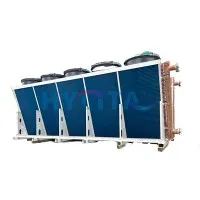
Hey there! As a supplier of Economizer Tubes, I've seen firsthand how crucial the tube arrangement can be for the overall efficiency of economizer tubes. In this blog, I'll dive into the effects of tube arrangement on economizer tube efficiency and why it matters in real - world applications.
Let's start by understanding what an economizer is. Economizers are heat exchangers that recover heat from flue gases in industrial processes. They pre - heat the feedwater going into a boiler, which in turn saves energy and reduces fuel consumption. And the tubes within an economizer are the heart of this heat - recovery process.
One of the most significant factors influenced by tube arrangement is heat transfer. There are two main types of tube arrangements: in - line and staggered. An in - line arrangement is when the tubes are arranged in a straight grid pattern, one row after another. On the other hand, a staggered arrangement has the tubes in each row offset from the tubes in the adjacent rows.
In terms of heat transfer, the staggered arrangement generally outperforms the in - line one. When the flue gases flow through the economizer tubes, the staggered arrangement creates more turbulence. This turbulence helps the gases mix better, bringing more hot gas into contact with the tube surfaces. As a result, the heat transfer rate increases. More heat is transferred from the flue gases to the water inside the tubes, which means higher efficiency for the economizer.
For example, in a power plant, if the economizer tubes are arranged in a staggered pattern, it can lead to better utilization of the waste heat from the exhaust gases. You can check out Exhaust Gas Heat Exchanger to learn more about how heat exchangers work with exhaust gases and how tube arrangement can play a role.
Pressure drop is another important aspect affected by tube arrangement. Pressure drop refers to the loss of pressure as the flue gases pass through the economizer tubes. The in - line arrangement typically has a lower pressure drop compared to the staggered arrangement. Since the gases can flow more smoothly through the in - line tubes, there is less resistance.
However, this lower pressure drop in the in - line arrangement comes at a cost. As we mentioned earlier, the heat transfer is not as efficient as in the staggered arrangement. So, there's a trade - off. In some industrial setups where the pressure of the flue gases is limited, an in - line arrangement might be preferred to avoid excessive pressure loss. But in most cases where maximizing heat recovery is the goal, the slightly higher pressure drop in a staggered arrangement is worth it.
The fouling of tubes is also related to tube arrangement. Fouling occurs when deposits build up on the tube surfaces, which can reduce heat transfer efficiency. In an in - line arrangement, the flue gases flow more uniformly, and it's easier for particles to deposit on the tube surfaces. In contrast, the turbulent flow in a staggered arrangement can help prevent the build - up of deposits to some extent. The swirling motion of the gases can dislodge particles before they have a chance to stick to the tubes.


This is especially important in industries dealing with dirty flue gases, such as the cement or steel industry. A well - designed tube arrangement can reduce the frequency of tube cleaning and maintenance, saving both time and money. You can find more details about how to deal with fouling and the role of tube arrangement in Waste Heat Recovery.
The manufacturing and installation of economizer tubes are also affected by tube arrangement. An in - line arrangement is generally easier to manufacture and install. The straight - forward grid pattern simplifies the fabrication process, and it's easier to align the tubes during installation.
On the other hand, a staggered arrangement requires more precise manufacturing and installation. The tubes need to be accurately positioned to achieve the desired offset between rows. This can increase the manufacturing and installation costs, but again, the long - term benefits in terms of heat transfer efficiency often justify the extra expense.
When it comes to the cost - effectiveness of different tube arrangements, we need to consider the overall life - cycle cost. This includes the initial cost of manufacturing and installation, the cost of energy consumption, and the cost of maintenance.
For a long - term operation, a staggered arrangement might be more cost - effective. Even though it has higher upfront costs, the increased heat transfer efficiency can lead to significant energy savings over time. And the reduced fouling can also lower the maintenance costs.
In some applications, hybrid tube arrangements are also used. A hybrid arrangement combines the advantages of both in - line and staggered arrangements. For example, you could have an initial in - line section to minimize the pressure drop at the entrance and then a staggered section to maximize heat transfer. This kind of flexible design can be tailored to the specific requirements of different industrial processes.
The material of the economizer tubes also interacts with the tube arrangement. For instance, SS Economiser Heat Exchanger uses stainless steel tubes. Stainless steel has good corrosion resistance, which is important when dealing with aggressive flue gases. The tube arrangement can affect how the corrosion occurs. In a staggered arrangement, the better mixing of gases can ensure a more uniform temperature distribution on the tube surface, which can reduce the risk of localized corrosion.
In conclusion, the tube arrangement has a profound impact on the overall efficiency of economizer tubes. Whether it's heat transfer, pressure drop, fouling, manufacturing, or cost - effectiveness, every aspect is influenced by how the tubes are arranged. As an Economizer Tube supplier, I understand the importance of choosing the right tube arrangement for different industrial applications.
If you're in the market for economizer tubes or need advice on the best tube arrangement for your specific needs, don't hesitate to reach out. We can have a detailed discussion about your requirements and come up with the most suitable solution. Whether you're running a small - scale industrial plant or a large power station, the right tube arrangement can make a big difference in your energy savings and operational efficiency.
References
- Incropera, F. P., & DeWitt, D. P. (2002). Fundamentals of Heat and Mass Transfer. Wiley.
- Holman, J. P. (2002). Heat Transfer. McGraw - Hill.