


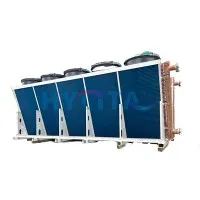
Hey there! As an air cooler supplier, I've been in the game for quite a while, and I've seen all sorts of air coolers. Today, I'm gonna break down the specs of a high - performance air cooler for you.
Cooling Capacity
First off, cooling capacity is a biggie. It's measured in British Thermal Units (BTUs) per hour. This tells you how much heat the air cooler can remove from a space in an hour. A high - performance air cooler usually has a high BTU rating. For small rooms, say around 100 - 200 square feet, an air cooler with 1000 - 2000 BTUs might do the trick. But if you're looking to cool a larger area, like a 500 - 600 square - foot living room, you'll want something with 3000 - 5000 BTUs or more.
The cooling capacity depends on a few factors. The size of the evaporator is one. A larger evaporator can absorb more heat. That's where our Copper Air Cooler Evaporator comes in. Copper is a great conductor of heat, so it can transfer heat from the air to the coolant inside the evaporator more efficiently.
Airflow Rate
Next up is the airflow rate. It's measured in cubic feet per minute (CFM). This number shows how much air the cooler can move through the unit in a minute. A high - performance air cooler has a high CFM rating. A good airflow rate ensures that the cooled air is distributed evenly throughout the room.
You don't want a cooler that just blows cold air in one spot. With a high CFM, the air can reach every corner of the room. For example, if you have a big open - plan office, you'll need an air cooler with a CFM of at least 500 - 1000. Our Hylita Surface Air Coolers | Industrial Finned Tube Heat Exchangers (Copper/SS304 SS306L) are designed to have a high airflow rate. The finned tubes increase the surface area for heat transfer, and at the same time, they help in pushing the air out more effectively.
Energy Efficiency
Energy efficiency is super important these days. You don't want to be stuck with a high - power - consuming air cooler that racks up your electricity bill. Look for the Energy Efficiency Ratio (EER). It's calculated by dividing the cooling capacity (in BTUs) by the power input (in watts). A higher EER means the cooler uses less energy to produce the same amount of cooling.
High - performance air coolers often come with energy - saving features. For instance, some have variable - speed fans. These fans can adjust their speed according to the temperature in the room. So, when it's not too hot, the fan runs at a lower speed, saving energy. Our Air Gas Cooler is designed with energy efficiency in mind. It uses advanced technology to keep the power consumption down while still providing excellent cooling.
Noise Level
No one wants a noisy air cooler. It can be really annoying, especially if you're using it in a bedroom or an office. The noise level is measured in decibels (dB). A high - performance air cooler should have a relatively low noise level.
Most modern air coolers are designed to operate quietly. They use noise - reducing materials and advanced fan designs. For example, some fans have aerodynamic blades that produce less noise when spinning. You should look for an air cooler that operates at around 40 - 50 dB. That's about as loud as a normal conversation, so it won't be too disruptive.


Build Quality and Durability
The build quality of an air cooler matters a lot. You want a cooler that can last for a long time. Look at the materials used. For example, a cooler with a metal body is usually more durable than one with a plastic body.
The components inside the cooler also need to be of high quality. The compressor, if it's a compressor - based air cooler, should be reliable. The fans should be well - made and balanced to avoid vibrations. Our air coolers are built to last. We use high - quality materials and test each unit thoroughly before it leaves the factory.
Humidity Control
Some air coolers also come with humidity control features. In some climates, especially in humid areas, you don't want the air to get too moist. A high - performance air cooler can help maintain the right humidity level in the room.
It can either remove excess moisture from the air or add a little moisture if the air is too dry. This is important for your comfort and also for the health of your skin and respiratory system.
Portability
If you need to move the air cooler around, portability is a key factor. Look for coolers with wheels and a lightweight design. Some air coolers are also designed to be easily disassembled for cleaning and storage.
For example, if you have a small business and you need to move the cooler from one room to another, a portable air cooler is a great option.
Maintenance
Maintenance is something that's often overlooked. A high - performance air cooler should be easy to maintain. It should have accessible filters that can be easily removed and cleaned.
The water tank, if it's an evaporative air cooler, should be easy to refill and clean. Regular maintenance ensures that the air cooler operates at its best and lasts longer.
Smart Features
In today's digital age, many air coolers come with smart features. You can control them using your smartphone or a smart home system. This allows you to adjust the temperature, fan speed, and other settings from anywhere.
Some smart air coolers can also learn your usage patterns and adjust themselves automatically. This is a great feature for convenience and energy savings.
So, there you have it - the main specifications of a high - performance air cooler. If you're in the market for an air cooler, and you're looking for high - quality products that meet all these specs, we're here to help. Whether you need a cooler for your home, office, or industrial space, we have a wide range of options to choose from.
If you're interested in learning more or making a purchase, feel free to get in touch with us. We'd be happy to have a chat and help you find the perfect air cooler for your needs. Let's start a conversation about how we can keep you cool!
References
- "Air Conditioning and Refrigeration Technology" by William C. Whitman, William M. Johnson, and John Tomczyk.
- Industry reports on air cooler technology and market trends.