


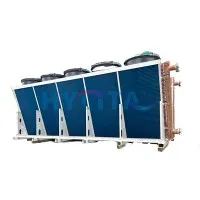
Hey there! As a supplier of dry coolers, I've been getting a lot of questions lately about the role of a fan in a dry cooler. So, I thought I'd take a few minutes to break it down for you.
First things first, let's talk about what a dry cooler is. A dry cooler is a heat exchanger that uses air to cool a fluid, usually water or a water-glycol mixture. It's commonly used in industrial and commercial applications, such as data centers, injection molding, and liquid immersion cooling.
Now, let's get to the main topic: the role of a fan in a dry cooler. The fan is a crucial component of a dry cooler, and it plays several important roles.
Air Circulation
The primary role of the fan in a dry cooler is to circulate air through the heat exchanger. The heat exchanger consists of a series of tubes or fins that contain the fluid to be cooled. As the fan blows air over the tubes or fins, it transfers heat from the fluid to the air. This process is known as convection, and it's the most common way to transfer heat in a dry cooler.
The amount of air that the fan can move is measured in cubic feet per minute (CFM). The higher the CFM, the more air the fan can move, and the more heat it can transfer. When choosing a fan for a dry cooler, it's important to consider the size of the heat exchanger and the amount of heat that needs to be removed. A larger heat exchanger or a higher heat load will require a fan with a higher CFM.
Heat Transfer Efficiency
In addition to circulating air, the fan also plays a role in improving the heat transfer efficiency of the dry cooler. The efficiency of a heat exchanger is measured by its effectiveness, which is the ratio of the actual heat transfer to the maximum possible heat transfer. The effectiveness of a dry cooler depends on several factors, including the design of the heat exchanger, the flow rate of the fluid, and the temperature difference between the fluid and the air.


The fan can improve the heat transfer efficiency of a dry cooler by increasing the velocity of the air over the tubes or fins. This increases the convective heat transfer coefficient, which is a measure of how easily heat can be transferred from the fluid to the air. A higher convective heat transfer coefficient means that more heat can be transferred in a given amount of time, which improves the overall efficiency of the dry cooler.
Noise Reduction
Another important role of the fan in a dry cooler is to reduce noise. Dry coolers can be quite noisy, especially when they're operating at high speeds. The fan can help to reduce noise by using a low-noise design and by operating at a lower speed.
There are several ways to reduce the noise of a fan, including using a larger fan with a lower RPM, using a fan with a aerodynamic design, and using a fan with a sound-absorbing material. When choosing a fan for a dry cooler, it's important to consider the noise level and to choose a fan that meets your requirements.
Energy Efficiency
Finally, the fan plays a role in improving the energy efficiency of the dry cooler. The energy efficiency of a dry cooler is measured by its coefficient of performance (COP), which is the ratio of the heat removed to the energy consumed. A higher COP means that the dry cooler is more energy-efficient.
The fan can improve the energy efficiency of a dry cooler by using a variable-speed drive (VSD). A VSD allows the fan to operate at different speeds depending on the heat load. When the heat load is low, the fan can operate at a lower speed, which reduces energy consumption. When the heat load is high, the fan can operate at a higher speed, which increases the heat transfer rate.
Conclusion
In conclusion, the fan is a crucial component of a dry cooler, and it plays several important roles. It circulates air through the heat exchanger, improves the heat transfer efficiency, reduces noise, and improves the energy efficiency. When choosing a fan for a dry cooler, it's important to consider the size of the heat exchanger, the amount of heat that needs to be removed, the noise level, and the energy efficiency.
If you're in the market for a dry cooler, we offer a wide range of products to meet your needs. Check out our Data Center Dry Cooler, Injection Mold Cooling Dry Cooler, and Liquid Immersion Cooling Dry Cooler for more information.
If you have any questions or would like to discuss your specific requirements, please don't hesitate to contact us. We're here to help you find the right dry cooler for your application.
References
- Incropera, F. P., & DeWitt, D. P. (2002). Fundamentals of heat and mass transfer. Wiley.
- Kreith, F., & Bohn, M. S. (2001). Principles of heat transfer. Cengage Learning.