


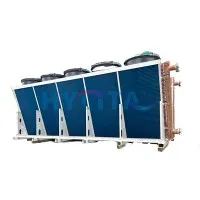
In the realm of industrial and commercial cooling, the pursuit of energy - efficient chiller cooling solutions is not just a trend but a necessity. As a chiller cooling supplier, I've witnessed firsthand the evolution of chiller technologies and the growing demand for systems that can provide optimal cooling while minimizing energy consumption. In this blog, we'll explore different types of chiller cooling and determine which one stands out as the most energy - efficient.
Air - Cooled Chillers
Air - cooled chillers are a popular choice in many applications due to their simplicity and relatively low installation costs. These chillers use ambient air to dissipate heat from the refrigerant. The process involves a compressor that compresses the refrigerant, raising its temperature and pressure. The hot refrigerant then flows through a condenser coil, where the ambient air, blown by fans, cools it down and condenses it back into a liquid state.
One of the main advantages of air - cooled chillers is their ease of installation. They don't require a separate cooling tower or a complex water - based cooling system, which can save both space and initial investment. However, air - cooled chillers are generally less energy - efficient than water - cooled chillers. The efficiency of an air - cooled chiller is highly dependent on the ambient air temperature. In hot climates, the cooling capacity of the chiller can be significantly reduced, and the compressor has to work harder to achieve the desired cooling effect, leading to higher energy consumption.
Water - Cooled Chillers
Water - cooled chillers, on the other hand, use water as the cooling medium to remove heat from the refrigerant. The basic operation is similar to air - cooled chillers, but instead of air, water is circulated through the condenser to absorb the heat. The heated water is then pumped to a cooling tower, where it is cooled by evaporating a small portion of the water into the atmosphere.
Water - cooled chillers are typically more energy - efficient than air - cooled chillers. Water has a higher heat capacity than air, which means it can absorb more heat per unit volume. This allows water - cooled chillers to operate at lower condensing temperatures, reducing the workload on the compressor and thus saving energy. Additionally, water - cooled chillers can maintain a more stable cooling capacity regardless of the ambient air temperature, making them a better choice for applications that require consistent cooling.
However, water - cooled chillers also have some drawbacks. They require a more complex installation, including a cooling tower, pumps, and piping. The maintenance of a water - cooled system is also more involved, as the cooling tower needs regular cleaning and water treatment to prevent the growth of bacteria and scale formation.
Absorption Chillers
Absorption chillers offer a different approach to cooling. Instead of using a compressor to compress the refrigerant, absorption chillers use a heat source, such as steam, hot water, or natural gas, to drive the cooling process. The basic principle involves an absorber, a generator, a condenser, and an evaporator.
In an absorption chiller, a refrigerant (usually water) is absorbed by an absorbent (such as lithium bromide). The solution is then heated in the generator, causing the refrigerant to vaporize. The vapor is then condensed in the condenser, and the liquid refrigerant is expanded into the evaporator, where it absorbs heat from the chilled water. The absorbent, now with less refrigerant, returns to the absorber to repeat the cycle.
Absorption chillers can be very energy - efficient, especially in applications where there is a readily available waste heat source. By utilizing waste heat, the chiller can produce cooling with little or no additional energy input. This makes absorption chillers a great option for industrial processes, hospitals, and large commercial buildings with cogeneration systems. However, absorption chillers are generally more expensive to purchase and install than compression - type chillers, and their efficiency can be affected by the quality of the heat source.
Hybrid Chillers
Hybrid chillers combine the features of different chiller technologies to achieve the best of both worlds. For example, some hybrid chillers combine an air - cooled condenser with a water - cooled condenser. During mild weather conditions, the air - cooled condenser can be used, which is more energy - efficient in terms of water consumption. When the ambient air temperature is too high, the water - cooled condenser can be activated to maintain the cooling capacity.


Another type of hybrid chiller is the combination of a compression chiller and an absorption chiller. The compression chiller can be used for the base load cooling, while the absorption chiller can be used to handle peak loads or to utilize waste heat. This way, the overall energy consumption of the cooling system can be optimized.
Energy - Efficient Components
In addition to the type of chiller, the energy efficiency of a chiller cooling system also depends on the components used. For example, a high - efficiency compressor can significantly reduce the energy consumption of a chiller. Variable - speed drives (VSDs) can be installed on the compressor, fans, and pumps to adjust their speed according to the cooling demand, saving energy during part - load conditions.
Advanced control systems can also play a crucial role in improving energy efficiency. These systems can monitor the temperature, pressure, and flow rate of the refrigerant and chilled water, and adjust the operation of the chiller accordingly. For instance, a smart control system can optimize the start - stop sequence of the chiller and its components to minimize energy waste.
Specific Energy - Efficient Products
As a chiller cooling supplier, we offer several energy - efficient products. Our Stainless Steel Air Fin Cooler is designed with high - quality stainless steel materials, which not only provide excellent corrosion resistance but also enhance the heat transfer efficiency. The unique fin design increases the surface area for heat exchange, allowing for more effective cooling with less energy consumption.
Our Chiller Evaporator is another key component in our energy - efficient chiller systems. It is engineered to maximize the heat transfer between the refrigerant and the chilled water, ensuring that the cooling process is as efficient as possible. The evaporator's design takes into account factors such as fluid flow distribution and refrigerant phase change, resulting in a high - performance and energy - saving product.
For applications where free cooling is available, our Air Chiller with Free Cooling is an ideal choice. This chiller can utilize the cold ambient air during winter or at night to provide cooling without running the compressor, which can lead to significant energy savings over time.
Conclusion
So, which type of chiller cooling is most energy - efficient? The answer depends on various factors, including the application, the ambient conditions, and the availability of energy sources. In general, water - cooled chillers are more energy - efficient than air - cooled chillers due to the higher heat capacity of water. Absorption chillers can be extremely energy - efficient when waste heat is available. Hybrid chillers offer a flexible solution that can optimize energy consumption by combining different technologies.
As a chiller cooling supplier, we understand that every customer's needs are unique. We are committed to providing customized energy - efficient chiller solutions that meet your specific requirements. Whether you need a simple air - cooled chiller for a small office or a complex absorption chiller for an industrial plant, we have the expertise and products to help you achieve your cooling goals while minimizing energy costs.
If you are interested in learning more about our chiller cooling products or would like to discuss a potential project, please feel free to contact us. Our team of experts is ready to assist you in finding the most suitable and energy - efficient chiller solution for your business.
References
ASHRAE Handbook of Refrigeration. American Society of Heating, Refrigerating and Air - Conditioning Engineers.
Dossat, R. J. (1991). Principles of Refrigeration. Prentice - Hall.
Kreider, J. F., & Rabl, A. (1994). Thermal Environmental Engineering. McGraw - Hill.