


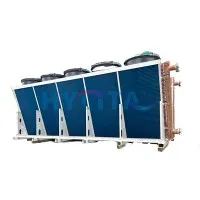
Hey there! As a supplier of dry coolers, I often get asked about how these nifty pieces of equipment interact with a building's HVAC (Heating, Ventilation, and Air Conditioning) system. So, let's dive right in and break it down.
First off, what's a dry cooler? Well, it's a heat exchanger that cools a fluid (usually water or a water - glycol mixture) by transferring heat from the fluid to the ambient air. Unlike wet cooling towers that use evaporation to cool the fluid, dry coolers rely solely on air - to - fluid heat transfer. This makes them a great option in areas where water is scarce or where water treatment and maintenance are a hassle.
Now, let's talk about how a dry cooler fits into the big picture of a building's HVAC system. The HVAC system is responsible for maintaining a comfortable indoor environment by controlling temperature, humidity, and air quality. It typically consists of three main parts: heating, ventilation, and air conditioning.
Cooling in the HVAC System
One of the key functions of an HVAC system is cooling. In large commercial or industrial buildings, a chiller is often used to cool the water that circulates through the building's air - handling units. The chiller removes heat from the water, and then the cooled water is distributed to the air - handling units to cool the indoor air.
This is where the dry cooler comes in. After the chiller has done its job, the warm water that has absorbed heat from the indoor environment needs to be cooled down again so that it can be recirculated through the chiller. That's the task of the dry cooler. The warm water from the chiller is pumped into the dry cooler, where it passes through a series of tubes or coils. As the ambient air is blown over these tubes by fans, heat is transferred from the water to the air, cooling the water down.
Types of Dry Coolers and Their Interaction
We offer different types of dry coolers, each with its own unique way of interacting with the HVAC system.
Horizontal Dry Cooler
The Horizontal Dry Cooler is a popular choice for many HVAC applications. Its horizontal design allows for easy installation, especially in areas with limited vertical space. In an HVAC system, the horizontal dry cooler can be placed on the roof or at ground level. The warm water from the chiller is piped into the horizontal dry cooler, and as the air flows horizontally across the coils, the heat is dissipated. This cooled water is then sent back to the chiller, completing the cooling cycle.
Glycol Dry Cooler
The Glycol Dry Cooler is designed to work with a water - glycol mixture. Glycol is added to the water to lower its freezing point, which is especially useful in cold climates. In an HVAC system, the glycol dry cooler ensures that the water - glycol mixture remains at the right temperature. The warm mixture from the chiller is cooled in the glycol dry cooler, and since glycol has anti - freeze properties, it prevents the fluid from freezing during cold weather. This is crucial for the continuous operation of the HVAC system, as frozen pipes can cause significant damage.
Server Dry Cooler
In data centers, where servers generate a huge amount of heat, the Server Dry Cooler plays a vital role. The HVAC system in a data center is responsible for keeping the servers at a stable temperature. The server dry cooler cools the water that is used to remove heat from the servers. The warm water from the server cooling system is sent to the server dry cooler, where it is cooled by the ambient air. This cooled water is then recirculated back to the servers, ensuring that they operate within the optimal temperature range.
Advantages of Using a Dry Cooler in an HVAC System
There are several advantages to using a dry cooler in a building's HVAC system.
Water Conservation
As mentioned earlier, dry coolers don't rely on evaporation to cool the fluid. This means that they use significantly less water compared to wet cooling towers. In regions where water is a precious resource, this can be a major selling point. By using a dry cooler, building owners can reduce their water consumption and lower their water bills.
Low Maintenance
Dry coolers are relatively low - maintenance compared to other cooling systems. There's no need for water treatment chemicals, and there are fewer components that can break down. This translates to lower maintenance costs and less downtime for the HVAC system.
Environmental Friendliness
Since dry coolers don't use water treatment chemicals and have a lower water footprint, they are more environmentally friendly. They also produce less noise compared to some other cooling systems, which is a plus for buildings located in residential or noise - sensitive areas.
Challenges and Solutions
Of course, using a dry cooler in an HVAC system isn't without its challenges. One of the main challenges is the efficiency of the dry cooler in hot weather. When the ambient air temperature is high, the dry cooler's ability to cool the fluid is reduced.


To overcome this challenge, we can use a combination of dry coolers and other cooling methods. For example, in extremely hot weather, a small amount of water can be sprayed on the coils of the dry cooler to enhance the cooling effect. This is known as an adiabatic pre - cooling system. Another solution is to use a larger dry cooler than what is typically required, so that it can still provide sufficient cooling even in high - temperature conditions.
How to Optimize the Interaction
To ensure that the dry cooler interacts effectively with the building's HVAC system, proper sizing and installation are crucial. The dry cooler needs to be sized correctly based on the cooling load of the HVAC system. This involves calculating the amount of heat that needs to be removed from the water and selecting a dry cooler with the appropriate capacity.
During installation, it's important to ensure that the dry cooler is placed in a location where it can receive adequate airflow. Obstructions such as walls or other equipment can reduce the airflow and affect the cooling performance. The piping system also needs to be properly installed to minimize pressure drops and ensure smooth circulation of the fluid.
Conclusion
In conclusion, a dry cooler is an essential component of a building's HVAC system. It plays a crucial role in cooling the water that circulates through the system, ensuring that the indoor environment remains comfortable. Whether it's a Horizontal Dry Cooler, Glycol Dry Cooler, or Server Dry Cooler, each type has its own unique way of interacting with the HVAC system.
If you're in the market for a dry cooler for your building's HVAC system, we'd love to talk to you. Our team of experts can help you select the right dry cooler, ensure proper installation, and provide ongoing support. Contact us to start a conversation about how we can meet your cooling needs.
References
- ASHRAE Handbook - HVAC Systems and Equipment
- Cooling Technology Institute (CTI) Standards
- Manufacturer's documentation for dry coolers and HVAC components