


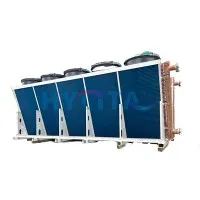
When it comes to dry coolers, one of the most debated topics in the industry is the choice between direct - expansion and flooded systems. As a dry cooler supplier, I've witnessed firsthand the different needs and preferences of our customers, and I'm here to break down the pros and cons of each system to help you make an informed decision.
Direct - Expansion Dry Coolers
Direct - expansion (DX) dry coolers operate on a relatively straightforward principle. In a DX system, the refrigerant directly evaporates inside the coil of the dry cooler. The heat from the process fluid (such as water or a glycol mixture) is transferred to the refrigerant, causing it to change from a liquid to a vapor state. This vapor is then compressed, condensed, and recycled back into the system.
Advantages of Direct - Expansion Dry Coolers
- Energy Efficiency: DX systems are often more energy - efficient compared to flooded systems, especially in partial - load conditions. Since the refrigerant evaporates directly in the coil, there is no need for an additional intermediate fluid to transfer heat. This reduces the energy losses associated with heat transfer between multiple fluids. For example, in a data center where the cooling load varies throughout the day, a DX dry cooler can adjust its operation more precisely to match the actual cooling demand, resulting in significant energy savings.
- Compact Design: DX dry coolers typically have a more compact design. Without the need for a large reservoir of refrigerant or an additional heat exchanger, the overall size of the unit can be smaller. This is particularly beneficial in applications where space is limited, such as in urban data centers or industrial facilities with tight floor plans.
- Easier Installation: The installation process of a DX dry cooler is generally simpler. There are fewer components to install and connect, and the system can be integrated more easily into existing HVAC or industrial cooling systems. This can save both time and labor costs during the installation phase.
Disadvantages of Direct - Expansion Dry Coolers
- Limited Capacity: DX systems may have limitations in terms of cooling capacity. As the size of the system increases, it becomes more challenging to ensure uniform refrigerant distribution across the coil. This can lead to uneven cooling performance and reduced efficiency. For large - scale industrial applications or data centers with high - density server racks, a DX dry cooler may not be able to provide sufficient cooling capacity.
- Sensitivity to Refrigerant Charge: The performance of a DX dry cooler is highly dependent on the correct refrigerant charge. An over - or under - charged system can significantly affect its efficiency and cooling capacity. Maintaining the proper refrigerant charge requires regular monitoring and adjustment, which can be a complex and time - consuming task.
Flooded Dry Coolers
In a flooded dry cooler, the refrigerant completely fills the coil, and the heat transfer occurs as the process fluid passes through the coil. The refrigerant remains in a liquid state throughout most of the heat - transfer process, and only a small portion of it evaporates.
Advantages of Flooded Dry Coolers
- High Cooling Capacity: Flooded dry coolers are well - suited for applications that require high cooling capacity. The design allows for a more uniform heat transfer across the coil, even in large - scale systems. This makes them ideal for industrial processes such as power generation, chemical manufacturing, and large - scale data centers. For instance, in a large - scale data center with thousands of servers, a flooded dry cooler can effectively handle the high heat loads generated by the equipment.
- Better Refrigerant Distribution: Unlike DX systems, flooded dry coolers are less sensitive to refrigerant distribution issues. Since the coil is filled with refrigerant, there is a more consistent flow of refrigerant across the entire surface of the coil, ensuring uniform cooling performance.
- Robustness and Reliability: Flooded dry coolers are generally more robust and reliable. They are less likely to be affected by minor variations in operating conditions, such as changes in ambient temperature or process fluid flow rate. This makes them a preferred choice for critical applications where uninterrupted cooling is essential.
Disadvantages of Flooded Dry Coolers
- Higher Energy Consumption: Flooded dry coolers typically consume more energy compared to DX systems, especially at partial loads. The large volume of refrigerant in the system requires more energy to circulate and maintain the proper operating conditions. In applications where the cooling load varies significantly, this can result in higher operating costs.
- Larger Footprint: Due to the need for a larger refrigerant reservoir and additional components, flooded dry coolers usually have a larger footprint. This can be a drawback in applications where space is at a premium.
- Complex Installation and Maintenance: The installation and maintenance of a flooded dry cooler are more complex. There are more components to install, and the system requires more precise calibration and monitoring. This can increase the initial installation costs and the long - term maintenance requirements.
Application Considerations
The choice between a direct - expansion and a flooded dry cooler depends on several factors, including the specific application, cooling capacity requirements, available space, and energy efficiency goals.
- Data Centers: In small - to - medium - sized data centers, a direct - expansion dry cooler may be a suitable choice. Its energy efficiency and compact design can help reduce operating costs and save valuable floor space. For example, a Server Dry Cooler with a DX system can provide efficient cooling for a few hundred servers. However, in large - scale data centers with high - density server racks, a flooded dry cooler may be necessary to handle the high heat loads.
- Industrial Processes: Industrial processes often require high - capacity cooling solutions. Flooded dry coolers are commonly used in applications such as power generation, chemical processing, and metalworking. For instance, a Liquid Immersion Cooling Dry Cooler with a flooded system can effectively cool the immersion fluid used in liquid - cooled servers. However, in some smaller industrial applications where energy efficiency is a priority, a direct - expansion dry cooler may be a better option.
- Commercial Buildings: In commercial buildings, the choice between the two types of dry coolers depends on the size of the building and the cooling load. For smaller commercial buildings, a direct - expansion dry cooler can be integrated into the HVAC system more easily and save energy. In larger commercial complexes, a flooded dry cooler may be required to meet the high cooling demands. A Horizontal Dry Cooler can be a good choice for commercial buildings with limited vertical space.
Conclusion
Both direct - expansion and flooded dry coolers have their own unique advantages and disadvantages. As a dry cooler supplier, I understand that every customer's needs are different, and there is no one - size - fits - all solution. When considering which type of dry cooler is better for your application, it's important to carefully evaluate your specific requirements, including cooling capacity, energy efficiency, space availability, and budget.
If you're still unsure which type of dry cooler is right for your project, or if you have any questions about our dry cooler products, I encourage you to reach out to us. Our team of experts is ready to assist you in making the best decision for your cooling needs and guide you through the procurement process.


References
- ASHRAE Handbook - HVAC Systems and Equipment.
- International Journal of Refrigeration, various issues on dry cooler technology.
- Manufacturer's technical documentation on direct - expansion and flooded dry coolers.