


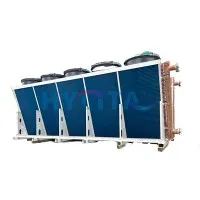
The pressure drop across a condenser coil is a critical parameter in the operation of any refrigeration or air - conditioning system. As a leading condenser coil supplier, we understand the importance of this concept and its implications for system performance. In this blog, we will delve into what pressure drop across a condenser coil is, its causes, effects, and how to manage it effectively.
Understanding Pressure Drop
Pressure drop, in simple terms, refers to the decrease in pressure that occurs as a fluid (either a gas or a liquid) flows through a component in a system. In the context of a condenser coil, it is the difference in pressure between the inlet and the outlet of the coil. The refrigerant enters the condenser coil at a relatively high pressure and temperature, and as it flows through the coil, it releases heat to the surrounding environment and undergoes a phase change from a vapor to a liquid. During this process, there is a reduction in pressure.
Mathematically, pressure drop ($\Delta P$) is calculated as:


$\Delta P = P_{inlet}-P_{outlet}$
where $P_{inlet}$ is the pressure of the refrigerant at the coil's inlet and $P_{outlet}$ is the pressure at the outlet.
Causes of Pressure Drop in Condenser Coils
Friction
One of the primary causes of pressure drop in condenser coils is friction. As the refrigerant flows through the tubes of the coil, it rubs against the inner walls of the tubes. This frictional force opposes the flow of the refrigerant, causing a loss of pressure. The magnitude of the frictional pressure drop depends on several factors, including the roughness of the tube walls, the velocity of the refrigerant, and the length and diameter of the tubes.
Pipe Bends and Fittings
Condenser coils often contain bends, elbows, and other fittings to direct the flow of the refrigerant. These changes in the flow path cause the refrigerant to change direction, which results in additional pressure losses. The more complex the coil's piping layout, the greater the pressure drop due to bends and fittings.
Phase Change
The phase change of the refrigerant from a vapor to a liquid within the condenser coil also contributes to pressure drop. As the refrigerant condenses, its density increases, and the volume decreases. This change in physical properties affects the flow characteristics of the refrigerant and leads to a reduction in pressure.
Effects of Pressure Drop
Reduced System Efficiency
A significant pressure drop across the condenser coil can have a detrimental effect on the overall efficiency of the refrigeration or air - conditioning system. When the pressure drop is high, the compressor has to work harder to maintain the required pressure difference across the system. This increased workload leads to higher energy consumption and lower system efficiency.
Compressor Wear and Tear
The extra work required by the compressor due to high pressure drop can cause accelerated wear and tear. The compressor is one of the most critical and expensive components in the system, and premature failure can result in costly repairs and downtime.
Inadequate Cooling Capacity
Excessive pressure drop can also lead to inadequate cooling capacity. If the pressure drop is too high, the refrigerant may not be able to flow through the system at the required rate, which can result in insufficient heat transfer in the condenser coil. This, in turn, can lead to higher refrigerant temperatures and reduced cooling performance.
Measuring Pressure Drop
To accurately assess the pressure drop across a condenser coil, pressure sensors are typically installed at the inlet and outlet of the coil. These sensors measure the pressure of the refrigerant at each point, and the difference between the two readings gives the pressure drop. Regular monitoring of pressure drop is essential to detect any changes in the system's performance over time.
Managing Pressure Drop
Proper Coil Design
As a condenser coil supplier, we pay close attention to the design of our coils to minimize pressure drop. This includes selecting the appropriate tube diameter, length, and layout. Smooth - walled tubes with a larger diameter can reduce frictional pressure drop, while a well - designed piping layout can minimize the number of bends and fittings.
Refrigerant Selection
The choice of refrigerant can also affect pressure drop. Different refrigerants have different physical properties, such as viscosity and density, which can influence the flow characteristics and pressure drop in the condenser coil. We work closely with our customers to select the most suitable refrigerant for their specific applications.
Regular Maintenance
Regular maintenance of the condenser coil is crucial to ensure optimal performance and minimize pressure drop. This includes cleaning the coil to remove dirt, debris, and other contaminants that can restrict the flow of the refrigerant. Additionally, checking for leaks and ensuring proper refrigerant levels can help maintain the system's efficiency.
Applications of Our Condenser Coils
Our condenser coils are used in a wide range of applications. For industrial settings, our Industrial Condenser Unit is designed to handle high - load cooling requirements. These units are built to withstand harsh industrial environments and provide reliable performance.
In the data center industry, our Condenser and Coil for Data Center Cooling are essential for maintaining the optimal temperature of servers and other equipment. With the increasing demand for data storage and processing, efficient cooling solutions are more important than ever.
For marine applications, our Marine Condenser Unit are designed to operate in the challenging marine environment. They are corrosion - resistant and can provide effective cooling for marine vessels.
Conclusion
Understanding the pressure drop across a condenser coil is crucial for the proper operation and maintenance of refrigeration and air - conditioning systems. As a condenser coil supplier, we are committed to providing high - quality coils that minimize pressure drop and maximize system efficiency. If you are in the market for a reliable condenser coil solution, we invite you to contact us for a detailed discussion about your specific requirements. Our team of experts is ready to assist you in selecting the right product for your application.
References
- ASHRAE Handbook - Refrigeration. American Society of Heating, Refrigerating and Air - Conditioning Engineers.
- Incropera, F. P., & DeWitt, D. P. (2002). Fundamentals of Heat and Mass Transfer. John Wiley & Sons.
- Stoecker, W. F., & Jones, J. W. (1982). Refrigeration and Air Conditioning. McGraw - Hill.