


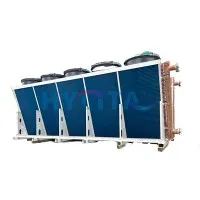
In the realm of pharmaceutical manufacturing, maintaining a stable and appropriate temperature is of utmost importance. A dry cooler plays a pivotal role in the cooling system of pharmaceutical manufacturing facilities. As a dry cooler supplier, I am excited to share with you how a dry cooler operates within a pharmaceutical manufacturing cooling system.


The Basics of a Dry Cooler
A dry cooler is a heat exchanger that uses ambient air to cool a fluid, typically water or a water - glycol mixture. It works on the principle of heat transfer, where the hot fluid from the pharmaceutical manufacturing process is circulated through a series of tubes within the dry cooler. The ambient air is then forced over these tubes by fans, removing heat from the fluid and dissipating it into the atmosphere.
The main components of a dry cooler include the heat exchanger coils, fans, and a frame. The heat exchanger coils are usually made of copper or aluminum, which are excellent conductors of heat. The fans are responsible for drawing in the ambient air and passing it over the coils. The frame provides structural support for the entire unit.
The Role in Pharmaceutical Manufacturing Cooling System
In a pharmaceutical manufacturing plant, various processes generate heat. For example, in the production of drugs, chemical reactions often release a significant amount of heat. Additionally, equipment such as reactors, fermenters, and distillation columns also produce heat during operation. If this heat is not removed efficiently, it can have a detrimental impact on the quality and stability of the pharmaceutical products.
A dry cooler is integrated into the cooling system to remove this excess heat. It is connected to the process equipment through a piping system. The hot coolant from the equipment is pumped into the dry cooler, where it is cooled before being returned to the equipment. This closed - loop system ensures that the temperature of the process equipment remains within the desired range.
How a Dry Cooler Works Step - by - Step
- Fluid Inlet: The hot fluid, which has absorbed heat from the pharmaceutical manufacturing process, enters the dry cooler through the fluid inlet. This fluid is usually a mixture of water and glycol, which has good heat - transfer properties and can prevent freezing in cold environments.
- Heat Exchange: Once inside the dry cooler, the fluid flows through the heat exchanger coils. The fans draw in ambient air and force it over the coils. As the air passes over the coils, heat is transferred from the hot fluid inside the coils to the ambient air. The rate of heat transfer depends on several factors, including the surface area of the coils, the temperature difference between the fluid and the air, and the air velocity.
- Cooled Fluid Outlet: After the heat has been transferred to the ambient air, the cooled fluid exits the dry cooler through the fluid outlet. It is then pumped back to the pharmaceutical manufacturing equipment to absorb more heat.
- Air Exhaust: The heated air, which has absorbed heat from the fluid, is exhausted from the dry cooler by the fans. This air is released into the atmosphere, and the process continues as long as there is a need to cool the fluid.
Types of Dry Coolers in Pharmaceutical Manufacturing
There are several types of dry coolers that can be used in pharmaceutical manufacturing cooling systems.
- Horizontal Dry Cooler: This type of dry cooler has a horizontal configuration, which makes it suitable for installations where space is limited. The horizontal design allows for easy access to the components for maintenance and repair. It is also less prone to water pooling, which can be a problem in some vertical designs.
- Server Dry Cooler: Server dry coolers are designed to provide efficient cooling for server rooms and data centers within pharmaceutical manufacturing facilities. They are often used to cool the electronic equipment that controls and monitors the manufacturing processes. These dry coolers are compact and can be easily integrated into existing cooling systems.
- V Dry Cooler: V - shaped dry coolers offer a high - performance cooling solution. The V - design increases the surface area of the heat exchanger coils, allowing for more efficient heat transfer. This type of dry cooler is suitable for large - scale pharmaceutical manufacturing plants where high - capacity cooling is required.
Advantages of Using a Dry Cooler in Pharmaceutical Manufacturing
- Energy Efficiency: Dry coolers are more energy - efficient compared to traditional water - cooled systems. They do not require a continuous supply of water for cooling, which reduces water consumption and associated costs. Additionally, the fans used in dry coolers can be controlled based on the cooling demand, further optimizing energy usage.
- Environmental Friendliness: Since dry coolers do not use water for cooling, they do not produce wastewater or require water treatment chemicals. This makes them a more environmentally friendly option compared to water - cooled systems.
- Low Maintenance: Dry coolers have fewer moving parts compared to water - cooled systems, which means they require less maintenance. The heat exchanger coils can be easily cleaned, and the fans can be serviced without the need for complex water treatment systems.
- Compact Design: Dry coolers are available in a variety of sizes and configurations, making them suitable for both small and large pharmaceutical manufacturing facilities. Their compact design allows for easy installation in limited spaces.
Considerations for Choosing a Dry Cooler in Pharmaceutical Manufacturing
When selecting a dry cooler for a pharmaceutical manufacturing cooling system, several factors need to be considered.
- Cooling Capacity: It is essential to determine the cooling capacity required to meet the specific needs of the pharmaceutical manufacturing process. This depends on factors such as the heat load generated by the equipment, the ambient temperature, and the desired temperature of the process fluid.
- Space Availability: The physical space available for the dry cooler installation should be considered. Different types of dry coolers have different space requirements, and it is important to choose a design that fits within the available space.
- Noise Level: In a pharmaceutical manufacturing environment, noise levels need to be kept to a minimum. Some dry coolers are designed to operate quietly, which is an important consideration, especially in areas where workers are present.
- Material Compatibility: The materials used in the dry cooler, such as the heat exchanger coils and the frame, need to be compatible with the fluid being cooled. This ensures long - term reliability and prevents corrosion.
Contact for Procurement and Consultation
If you are in the pharmaceutical manufacturing industry and are looking for a reliable dry cooler solution, I invite you to contact us for procurement and consultation. Our team of experts can help you select the most suitable dry cooler for your specific needs, taking into account factors such as cooling capacity, space availability, and energy efficiency. We are committed to providing high - quality dry coolers and excellent customer service. Whether you need a Horizontal Dry Cooler, a Server Dry Cooler, or a V Dry Cooler, we have the right product for you.
References
- ASHRAE Handbook - HVAC Systems and Equipment. American Society of Heating, Refrigerating and Air - Conditioning Engineers.
- Perry's Chemical Engineers' Handbook. McGraw - Hill Education.
- "Principles of Heat Transfer" by Frank Kreith and Raj M. Manglik. Cengage Learning.