


Heating Coils
Your Professional Heating Coils Supplier
Shenzhen Hylita Heat Exchange Equipment Co., Ltd. was established on July 2, 2015, located in Maluan Chuanggu Industrial Park, Jinlong Avenue, Shahu Community, Biling Street, Pingshan District, Shenzhen. The company focuses on the development and sales of refrigeration and heat exchange equipment technology, and also involves fields such as metal processing and component manufacturing.we have always been guided by meeting customer needs, continuously optimizing products and services, and gradually emerging as a promising enterprise in the field of heat exchange equipment.
Why Choose Us
Production Market
Our heat exchanger products are popular in multiple regions around the world, particularly in Southeast Asia where they are highly favored by customers in countries such as Indonesia, Malaysia, and Thailand. Due to the vigorous development of industry in Indonesia, the demand for heat exchangers has surged.
Our Service
Shenzhen Hylita Heat Exchange Equipment Co., Ltd. has established a full process service system to provide customers with professional and thoughtful support.
Our Factory
Shenzhen Hylita Heat Exchange Equipment Co., Ltd. is located in Guangdong, China, with a spacious factory of nearly 4000 square meters. There are currently 45 workers, and the annual production equipment requires over 20 million tons of metal materials.
On-Time Delivery
Our supply chain management and production processes operate efficiently to ensure your orders are delivered punctually.
Advantages of Heating Coils
Flexible Shapes and Customization: Electric coil heaters are highly ductile, enabling them to be shaped into virtually any configuration—straight, spiral, star, or custom-formed—making them suitable for retrofits and new installations alike.
Rapid Temperature Response: The low thermal mass of heating coils allows for quick heat-up and cool-down cycles, making them ideal for precision temperature control in industrial, commercial, and residential applications.
Durability and Reliability: With proper material selection and engineering, heating coils can endure repeated thermal cycling, harsh environments, and long operating hours with minimal maintenance.
Versatility and Wide Range of Applications: From sub-freezing cold storage to high-temperature process equipment, electric coil heaters are deployed in countless scenarios, including gas heating, liquid immersion, air heating, and surface heating.
Climatic Resilience: Advanced engineering allows heating coils to withstand severe weather, corrosive atmospheres, and demanding industrial conditions. In the oil and gas sector, they are critical for pipe trace heating and flow assurance.
Space Efficiency and Safety: Electric heating coils contain fewer moving parts, resulting in compact designs that minimize installation footprint. Integrated control boxes and safety devices—such as thermal cutoffs and ground fault protection—enhance operational safety, especially in immersion heater systems.
Energy Efficiency: Electric heating coil elements deliver high conversion efficiency, directly converting electrical energy to heat with minimal losses. This translates to cost savings, reduced emissions, and easier integration with automated process controls.
Strip Heaters
These are one of the most versatile types of heaters as they can be used in a range of applications. They’re also relatively affordable, making them a good option for those working with tight budgets.
Tubular Heaters
These heater coils are often used in applications where high temperatures are needed. They’re also corrosion-resistant, making them ideal for use in harsh environments.
Immersion Heaters
As the name implies, these heater coils are designed to be submerged in whatever medium you try to heat. This makes them ideal for use in liquids, but they can also be used in air and gases.
Design of Heating Coils
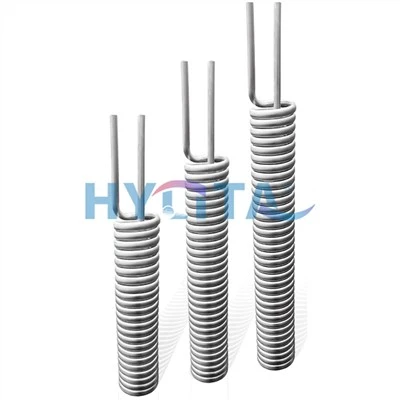
Spirally coiled heating elements
Compact, ideal for confined spaces, and commonly used in cartridge heaters and tubular heating elements.
Star-wrapped coils
Create turbulence within ducts and pipes, improving heat transfer efficiency in flowing air or liquid systems.
Flat and ribbon coils
Used in applications needing maximum surface contact or where uniform radiant heat is required.
Custom-formed coils
Engineered for specialized equipment, from laboratory instruments to industrial machinery.
How Heating Coils Work
Electrical Current
An alternating current (AC) flows through the coil, generating an electromagnetic field around it.
Induction Heating
The electromagnetic field induces eddy currents in the metal, causing its internal resistance to heat up.
Heat Transfer
The heat is transferred uniformly to the metal, enabling efficient melting or heat treatment.
Proper maintenance of heating coils is crucial to ensuring long-term performance and avoiding costly downtime. To extend the lifespan of your heating coils, follow these tips:
Firstly, regular cleaning is essential to keep the coil free from debris, dust, and metal splashes, which can reduce efficiency or cause damage.
Additionally, routine inspections are important; check the coil regularly for signs of wear or damage, such as cracks or discoloration, which could indicate the need for replacement.
Lastly, always monitor the temperature to prevent overheating, as this can weaken the coil material and shorten its lifespan.

Applications of Heating Coils
Metal Smelting and Melting
Used in foundries and metal production to melt materials like steel, aluminum, and copper.
Forging
Coils heat metals to high temperatures to make them pliable for forging into shapes.
Heat Treating
Coils are used to apply controlled heating for hardening or softening metals in industries such as aerospace and automotive.
We're professional heating coils manufacturers and suppliers in China, providing high quality customized products with low price. We warmly welcome you to wholesale heating coils for sale here from our factory.
heating coils, Stainless Heat Exchanger Coil