


```html
Cooling Tower Technology: Principles, Selection & Optimization for HVAC Systems
Cooling towers are indispensable components in central air conditioning systems, primarily responsible for cooling the circulating water to the required temperature to maintain normal system operation. Utilizing the principle of heat and mass transfer between water and air, cooling towers atomize or film the hot water, bringing it into direct contact with air to reduce water temperature while dissipating heat into the atmosphere, enabling the recycling of cooling water. Proper selection and operation of cooling towers not only significantly improve the energy efficiency of central air conditioning systems but also ensure stable system operation and reliability.
1. Working Principle of Cooling Towers
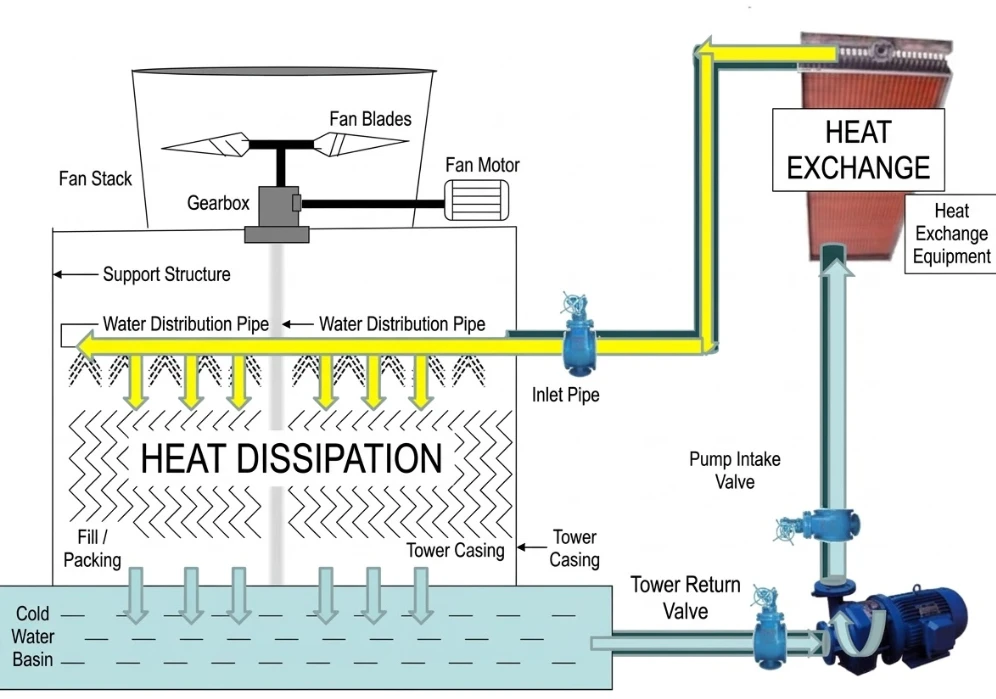
The working process of a cooling tower can be summarized as "water cooling, air heating." Specifically, when high-temperature cooling water flows through the fill surface inside the tower, it comes into full contact with air, achieving heat exchange through both sensible and latent heat transfer:
1.1 Sensible Heat Transfer
Due to the temperature difference between water droplets/film and air, according to the second law of thermodynamics, heat transfers from the higher-temperature object to the lower-temperature object, causing water temperature to drop and air temperature to rise. The sensible heat transfer rate follows Newton's law of cooling, proportional to the temperature difference and contact area.
1.2 Latent Heat Transfer
When high-temperature water contacts air, part of the water evaporates, forming water vapor. As water molecules change from liquid to gas, they absorb latent heat of vaporization, thus removing heat from the water and achieving cooling. Latent heat transfer accounts for more than 60% of the total heat transfer in cooling towers and is the main factor affecting cooling effectiveness. The amount of evaporation is closely related to parameters such as water temperature, air humidity, and contact time.
In addition to sensible and latent heat transfer, complex fluid flow and mass transfer processes exist within cooling towers, such as water mist formation and movement, air convection and diffusion, collectively affecting heat and mass transfer efficiency. Core components like fill, spray devices, and ventilation systems are designed to enhance these heat and mass transfer processes. Through reasonable optimization of internal components and process parameters, the heat exchange efficiency and operational performance of cooling towers can be significantly improved.
Key Parameters Affecting Cooling Tower Performance
- Inlet Air Temperature: Dry-bulb temperature of outside air, reflecting initial air heat capacity. Lower inlet air temperature yields better cooling effect.
- Wet-Bulb Temperature: Reflects air moisture content, a decisive factor affecting evaporative latent heat transfer. Lower wet-bulb temperature means stronger air absorption capacity for water vapor, resulting in better cooling.
- Inlet/Outlet Water Temperature: Initial and target temperatures of cooling water, representing the heat load to be transferred. Larger temperature difference provides stronger driving force and higher heat transfer rate.
- Water-to-Air Ratio: Water flow rate per unit air flow. Affects water droplet splashing, atomization, and air humidity change. Optimal water-to-air ratio typically ranges from 0.8 to 1.2.
- Fill Characteristics: Parameters such as specific surface area, porosity, and hydrophilicity determine water film formation quality and contact efficiency with air.
- Tower Height & Cross-Sectional Area: Affect water mist residence time and air velocity distribution. Greater height and larger cross-section improve heat exchange but increase investment and operating costs.
Therefore, in cooling tower design and operation, these parameters must be balanced to achieve optimal techno-economic performance while meeting cooling requirements.
2. Structural Types of Closed Cooling Towers
Common closed cooling towers are classified into cross-flow and counter-flow types based on air inlet direction and fill arrangement. Each type has distinct characteristics suitable for different applications.
2.1 Cross-Flow Cooling Towers
Cross-flow cooling towers feature air entering from the side, flowing perpendicularly to water film cascading down the fill, and exiting from the opposite side. Advantages include compact structure, small footprint, and uniform air distribution, making them ideal for space-constrained applications.
Main components: Tower body (FRP or stainless steel), water basin, fill (corrugated or honeycomb polypropylene), drift eliminator, fan (axial flow), motor (waterproof/explosion-proof, variable frequency capable).
2.2 Counter-Flow Cooling Towers
Counter-flow cooling towers feature air entering from the bottom, flowing upward opposite to the downward spraying hot water, and exiting from the top. Advantages include high fill utilization, low outlet water temperature, and low ventilation power requirements, suitable for large industrial cooling systems.
Main components: Tower body (reinforced concrete), water basin, fill (staggered, labyrinth structure), spray device (adjustable nozzles), louvers, fan and motor (top-mounted).

In addition to cross-flow and counter-flow types, there are other types such as combined-flow and radial-flow cooling towers, though less commonly used. Cooling tower selection requires comprehensive consideration of cooling load, inlet/outlet water temperature, wet-bulb temperature, footprint, noise control, and optimization of fill and spray system design parameters based on water quality, operating conditions, and economic requirements.
3. Cooling Tower Selection Methodology
Cooling tower selection determines technical parameters and specifications, directly affecting project investment costs and operational performance. Selection requires comprehensive analysis of the cooling tower's role in the air conditioning system, load characteristics, environmental conditions, following the principle of "selecting based on demand" while optimizing techno-economic indicators. The general selection steps are:
- Determine Cooling Load: Calculate the heat load that the cooling tower must handle based on air conditioning system design conditions, including cooling capacity, chilled water supply/return temperatures, and design flow rate.
- Select Design Conditions: Determine cooling tower performance requirements under different conditions based on meteorological parameters at the project location, such as summer design wet-bulb temperature and inlet dry-bulb temperature.
- Determine Fill Type: Select appropriate fill type and arrangement (e.g., honeycomb, staggered, labyrinth) based on cooling water quality, heat exchange requirements, and wind resistance characteristics.
- Select Tower Type and Arrangement: Choose appropriate cooling tower type (cross-flow or counter-flow), single tower capacity, and number of units based on available site area, landscape coordination, and noise control requirements.
- Optimize Structural Parameters: Under the premise of meeting cooling load, optimize fill specific surface area, spray density, ventilation coefficient, and other parameters to achieve optimal thermal performance and hydraulic conditions.
- Verify Operating Conditions: Check cooling tower performance under various conditions such as different loads, wet-bulb temperatures, and inlet water temperatures to ensure year-round operational capability.
- Determine Mechanical and Electrical Selection: Select efficient fans and motors based on air volume and static pressure parameters, optimizing impeller diameter, speed, and power while balancing reliability and economy.

Selection Calculation Example:
A large shopping mall uses a central air conditioning system with design cooling capacity of 3000kW, chilled water supply temperature 12°C, return temperature 7°C, design flow rate 350m³/h. The area has summer design wet-bulb temperature 28°C, cooling tower inlet dry-bulb temperature 35°C. Select appropriate cooling tower model and quantity.
Solution:
(1) Cooling tower heat load Q = Cooling capacity + Chilled water pump heat + Chiller energy consumption = 3000 + 350×(12-7)×4.186/3600 + 3000/4 = 4475kW
(2) Temperature difference Δt = (Q/c_p )/(ρ·q_v ) = (4475×3600)/(4.186×1000×350) = 11.6°C
(3) Water temperatures: t₁ = 12+11.6 = 23.6°C, t₂ = 12°C
(4) Select corrugated fill with specific surface area 150m²/m³, fill height 1.8m
(5) Consulting engineering manuals, under wet-bulb temperature 28°C, inlet water temperature 23.6°C, fill height 1.8m, estimated rated heat dissipation per tower is 1600kW
(6) Number of towers n = Q/Q_single = 4475/1600 = 2.8 ≈ 3 towers
(7) Considering practical selection, use 3 counter-flow cooling towers with 1600kW capacity each, operating in parallel
(8) Select FRP round counter-flow tower with outer diameter 4m, height 3.5m, equipped with 5.5kW variable frequency axial flow fan
Cooling tower selection requires trade-offs among design specifications, space conditions, water quality, material characteristics, operating conditions, and other factors to achieve optimal balance between cooling effect, investment cost, energy efficiency, and environmental friendliness. Additionally, control strategies during actual operation must be considered to avoid energy waste from excessive design margins.
4. Cooling Tower Water Flow Regulation
As terminal equipment in air conditioning cold source systems, cooling tower operating conditions fluctuate with indoor/outdoor loads, environmental parameters, system characteristics, and other factors. To adapt to these changes, flexible regulation of cooling water flow and temperature is needed to maintain tower thermal balance and improve partial load performance.
Common Flow Regulation Methods:
- Fixed Flow Two-Stage Regulation: Achieve 50% and 100% flow regulation by switching cooling water pumps on/off, suitable for systems with small load variations.
- Fixed Flow Multi-Stage Regulation: Achieve multi-stage flow regulation by switching multiple parallel small-flow cooling pumps, suitable for systems with moderate load variations.
- Variable Flow Continuous Regulation: Achieve stepless continuous flow regulation through variable frequency drive of cooling water pumps or control valves regulating return line resistance, suitable for systems with frequent load variations.
- Combined Regulation: Combine fixed and variable flow regulation methods to balance control accuracy and operational stability under different conditions.
Regulation Principles:
- Constant Temperature Regulation: Use PID controller to adjust cooling pump frequency or valve opening based on deviation between outlet water temperature and setpoint, stabilizing outlet water temperature.
- Constant Flow Regulation: Maintain constant cooling water pump flow while controlling fan speed via variable frequency drive to adjust heat load distribution and indirectly control outlet water temperature.
- Load Tracking Regulation: Use DDC controller to adjust cooling pump and fan operating parameters based on actual cooling demand, matching tower heat supply to load requirements.
- Optimization Regulation: Adjust operating parameters such as water-to-air ratio and heat load distribution to achieve energy savings while meeting cooling requirements.
Note: Flow regulation should avoid excessive frequency to reduce pump and fan start/stop cycles, extending equipment life. During regulation, closely monitor operating parameters such as water temperature, water level, and vibration to promptly identify and address abnormal conditions, ensuring safe and stable operation.
5. Conclusions & Insights
This article systematically reviews the working principles, structural types, selection methods, and operational control strategies of central air conditioning cooling towers, elaborating on their important role and applications as wet heat exchange equipment on the cold source side of air conditioning systems.
- Cooling towers utilize heat and mass transfer between water and air to reduce cooling water temperature, with sensible and latent heat transfer being the primary heat exchange mechanisms, while fill, spray, and fans are key components enhancing heat and mass transfer.
- Cross-flow and counter-flow are two common closed cooling tower types, each with distinct structural arrangements and air inlet characteristics, requiring reasonable selection based on project conditions.
- Cooling tower selection must comprehensively consider heat load, environmental parameters, water quality, balancing cooling effect, investment cost, energy consumption, and environmental performance while optimizing tower parameters and unit configuration.
- Various flow regulation methods (fixed flow, variable flow) with appropriate control strategies can significantly improve cooling tower partial load efficiency and operational flexibility in response to load and condition variations.
- Enhanced cooling tower operation monitoring and maintenance management are essential for ensuring safe, efficient, and long-term operation. Regular fill cleaning, fan maintenance, and water treatment are necessary to eliminate safety hazards.
- As building energy efficiency and air conditioning system optimization demands increase, efficient intelligent cooling tower products and complete technologies will see broader applications. Developing suitable cooling tower systems tailored to different climate zones, water resource conditions, and environmental requirements, optimizing design selection and control solutions, and improving coverage in urban air conditioning and industrial cooling sectors are significant for building resource-conserving and environment-friendly societies.
Consult Us for Custom Cooling Tower & Heat Exchange Solutions
If you have any cooling tower or heat exchanger customization needs, our engineers are ready to assist. We support international orders and OEM projects!
🏢 Company: Shenzhen Hylita Heat Exchanger Co., Ltd.
💬 WhatsApp/WeChat: +86 187 1771 1249
✉️ Email: info@hylita.com
```